DuckDuckGo Installs +30% After Google I/O 2026: What the AI Search Backlash Actually Means for SEO
TechCrunch reports DuckDuckGo US installs averaged +18.1% week-over-week and peaked at +30.5% on May 25, 2026, but DDG's own Google Trends interest peaked in 2024 and is now ~60% off that high. We compare the install surge to the search-interest curve, work through Lily Ray's 'why didn't this happen earlier' question, and lay out what it means for SEO teams.
TechCrunch's Rebecca Bellan reported on May 26, 2026 that DuckDuckGo installs spiked in the week after Google I/O. DDG CEO Gabriel Weinberg told TechCrunch: 'Google is force-feeding AI with no way to opt out. As a result, their results are getting worse, not better.'
- The reported numbers: US app installs averaged +18.1% week-over-week (May 20–25 vs May 13–18) and peaked at +30.5% on May 25, with iOS averaging +33% and peaking at +69.9%. Visits to the AI opt-out page averaged +22.7% week-over-week, peaking at +27.7% on May 24.
- The surface reading is wrong: Google Trends shows interest in 'DuckDuckGo' peaked at 100 in late 2023 and early 2024 and has since fallen about 60% to around 40, which looks like the reaction already happened in 2024.
- The StatCounter data says otherwise: DDG's US market share peaked at 2.42% in 2021 and was actually down to 1.96% by 2024. Daily searches peaked at 111.7M on Jan 17, 2022.
- So the 2024 spike was curiosity, not conversion: A news-cycle wave around AI search anxiety (DuckAssist, SGE, AI Overviews) that did not translate into install or market-share gains. That sharpens Lily Ray's May 27 question of why this didn't happen earlier: it half-happened in 2024 and didn't convert. May 2026 is the first time we have actual install-data evidence of behavior change.
- Critically for SEOs: Traditional DuckDuckGo web results still come primarily from Bing's index, confirmed by DDG's own help docs and by the August 2024 Bing API outage that visibly broke DDG.
The surge moves a measurable slice of US search traffic onto a stack most SEO teams don't actively monitor, and whether it sustains past June is the open question. Six concrete checks in the post.
TechCrunch reported on May 26, 2026 that DuckDuckGo US installs averaged +18.1% week-over-week (May 20–25) and peaked at +30.5% on May 25. The deeper story: DDG's web results come primarily from Bing's index, so the surge moves US search traffic onto a stack most teams don't monitor. Try CrawlRaven free: 1 site, no credit card →
On May 26, 2026, TechCrunch's Rebecca Bellan reported that DuckDuckGo's installs and opt-out traffic both jumped in the days after Google I/O:
- US app installs. Averaged +18.1% week-over-week over May 20–25 against the May 13–18 baseline, peaking at +30.5% on May 25.
- iOS specifically. Averaged +33%, with a single-day peak of +69.9%.
- The AI opt-out page, noai.duckduckgo.com. Averaged +22.7% week-over-week, peaking at +27.7% on May 24.
DDG CEO Gabriel Weinberg told TechCrunch: "Google is force-feeding AI with no way to opt out. As a result, their results are getting worse, not better."
Bellan's reporting connects the surge to Google I/O 2026 (May 19–20), which expanded AI Mode and Generative UI across Google Search: the biggest change to the Google SERP since AI Overviews launched two years ago.
The story has been picked up by every major SEO outlet. The most-shared reaction inside the SEO community came from Lily Ray, Senior Director of SEO & Organic Research at Amsive, and one of the most-followed practitioners in the space, who quoted the TechCrunch piece on X with one short line:

Will be interesting to see where this goes (also kinda curious why this didn’t happen earlier with AI Overviews)

DuckDuckGo installs are up 30% as users reject being ‘force-fed’ Google’s AI Search techcrunch.com/2026/05/26/duc…
That parenthetical is the better story. AI Overviews launched in the US on May 14, 2024, exactly two years before this TechCrunch piece.
If "Google is force-feeding AI" is the trigger for a 30% install week in 2026, why didn't the original AI Overviews launch trigger the same reaction in 2024? Either it did and nobody noticed at the time, or something is materially different about this cycle.
That's what this post is actually about. We pulled the Google Trends curve for "DuckDuckGo," cross-referenced it with StatCounter market-share data and DDG's own daily-search figures, and worked through what changed between 2024 and 2026, and what it means for SEO teams who almost certainly haven't been thinking about DuckDuckGo as a serious channel.
Three findings, each unpacked below:
- Lily's instinct was correct, and the data is sharper than it looks. Search interest in "DuckDuckGo" on Google Trends did spike during the 2023–2024 AI-search wave. But DDG's actual usage (market share, daily searches) peaked back in 2021, before any AI-search launch, and never recovered. So the 2024 reaction happened in curiosity, possibly in app downloads, but not in durable switching.
- The May 2026 wave is the first time install data is being publicly attributed to a specific Google AI event. Whether it converts to durable use is the open question. The May numbers won't answer it; the June and July ones will.
- For SEOs, the practical surface is Bing, not DuckDuckGo. Traditional DDG web results come primarily from Bing's index, confirmed by DDG's own help docs. A 30% week on DDG is a Bing-visibility story.
What TechCrunch actually reported (the verifiable numbers)
The headline "+30%" comes from a single-day peak on May 25, not a sustained run-rate. The averages over the six-day window are more modest, but iOS-specific growth is the real outlier.
The May 2026 DuckDuckGo surge, week-over-week growth
May 20–25, 2026 vs May 13–18 baseline · US · DDG-reported figures per TechCrunch
Solid bar = week-over-week average; dashed extent = single-day peak inside the window. Figures are growth rates, not absolute installs. DDG's typical US search market share is ~2% per StatCounter, so a +30% week is still a small slice of total US search demand.
All three metrics in Bellan's reporting are DDG-reported figures shared with TechCrunch. Neither App Store rankings nor third-party install-estimation services have independently confirmed them at this writing. The most reliable comparable is DDG's ~2% US search market share per StatCounter, which puts a +30% install week into context: DDG is gaining share on a small base, not displacing Google.
DDG attributed the surge to Google I/O 2026, where the company expanded AI Mode (Gemini 3.5 Flash as the default model) and rolled out Generative UI, search-results pages built on the fly by the model rather than served from the standard SERP template. Our I/O 2026 walkthrough covers the mechanics.
The Google Trends chart for "DuckDuckGo" (2004 → today)
Pull up Google Trends for "DuckDuckGo," set the range to 2004 – present, leave the geography at worldwide and the search type at web search, and you get this curve:
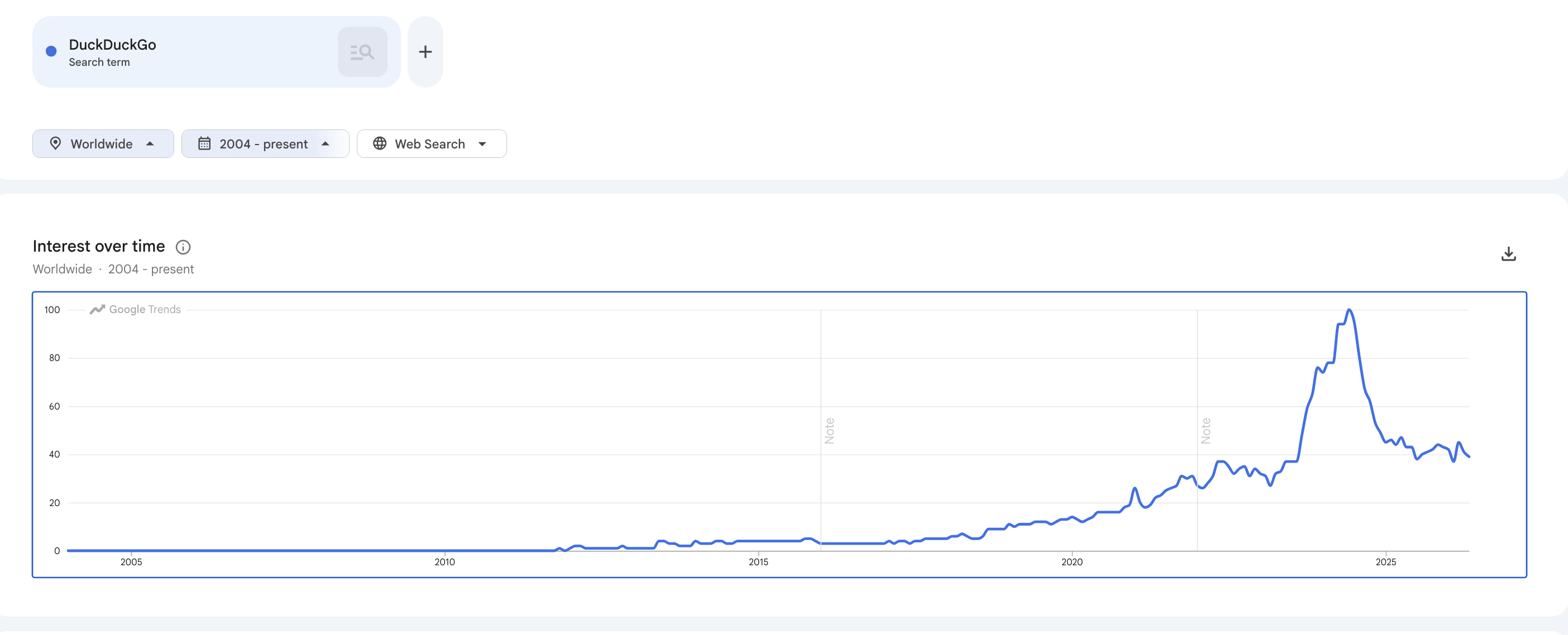
Source: Google Trends, "DuckDuckGo", Worldwide, Web Search, 2004 → present. Screenshot taken May 27, 2026.
Same curve, with two annotations added so we can talk about specific inflection points:
DuckDuckGo search interest peaked in 2024, and has fallen ~60% since
Google Trends · "DuckDuckGo" · Worldwide · Web Search · 2004 → May 2026
Reconstructed from a Google Trends screenshot taken May 27, 2026. Values are relative search interest, not absolute query volume: a reading of 100 means the highest point on this chart, not a fixed number of searches. The May 2026 install surge is not visible at this scale, because Trends measures interest in the term "DuckDuckGo," not app installs.
From near-zero in 2004 to a slow grind through the 2010s, DDG's search interest took off in 2020–2021 (privacy tailwinds, Big Tech antitrust attention), then spiked into a 100-reading peak in late 2023 / early 2024. Then the curve fell. From 100 at the peak to roughly 40 by mid-2025, where it's sat ever since.
The obvious reading is: "there was a 2024 reaction to AI Overviews that didn't convert into installs." That is the wrong reading. Google Trends measures interest in the search term, which is news-cycle driven. To see what actually happened on DDG you have to overlay the usage data, and it is a different shape entirely.
Interest peaked in 2024. Usage peaked in 2021. The leakage is in between.
Here's the disconnect that makes Lily Ray's question more interesting, not less:
Interest in "DuckDuckGo" ≠ DuckDuckGo usage
Search interest peaked in 2024 · Market share peaked in 2021 · 3-year gap
Google Trends interest values are visual approximations of the user-supplied screenshot (relative, not absolute). Market-share figures are StatCounter US averages compiled across published Backlinko / Statista / Electroiq / Earthweb reports. The 2024 interest peak coincided with the AI-search-anxiety wave (DuckAssist, SGE, AI Overviews), but DDG's market share that year was lower than in 2021, before any of those launches.
The usage data says DDG was already flat-to-declining before AI Overviews ever launched:
- US search market share. Per StatCounter, peaked at 2.42% in 2021 and was down to 1.96% in 2024.
- Daily searches. Peaked at 111.7 million on January 17, 2022 per DDG's own publicly tracked stats, then plateaued around 100M/day through 2024.
Two events worth keeping in mind when looking at this:
- The May 2022 Microsoft tracker scandal. Security researcher Zach Edwards discovered that DDG's browser allowed Microsoft trackers on third-party sites due to a syndication agreement with Bing. The public backlash was sharp; DDG amended the carve-out in August 2022. The damage to the privacy narrative was a durable headwind on growth.
- The 2023–2024 AI-search wave. ChatGPT (Nov 2022), DuckAssist (Mar 2023), Google's SGE (May 2023), Bing Chat / Copilot, and finally AI Overviews (May 14, 2024). The Google Trends "DuckDuckGo" line tracks that wave. The DDG market-share line does not.
Did downloads actually happen in 2024?
The honest answer: almost certainly some did. We just can't see exactly how big the spike was. If you Google-search for "DuckDuckGo" in the middle of an AI-search news cycle, the most common next click is the App Store. Public download numbers are too coarse to detect a 2024 bump cleanly:
- April 2024 Android installs are cited at ~1,000,000 in widely-syndicated stats. iOS the same month at ~500K.
- Current 2026 monthly estimates per Sensor Tower are roughly 1M Android + 600K iOS in the US. Roughly steady.
- Month-by-month time-series download data isn't public. Sensor Tower has it behind a paywall.
So the data we can see is consistent with a 2024 install spike that didn't break out of the monthly noise, or with one that happened but churned away. We can't cleanly distinguish those two without Sensor Tower's time series. What we can definitively say is what came next.
The downstream metrics, market share and daily searches, flatlined
Wherever 2024's installs sat in volume, they did not convert to durable usage. Market share went from 1.93% to 1.96%. Daily searches stayed at ~100M against a 2022 peak of 111.7M. The 2024 AI-search anxiety produced enough behavior to keep DDG on the map and not enough to grow it.
That's the actual finding: the leakage point isn't curiosity → install. It's install → durable use. People tried DDG and went back to Google.
Back to Lily's question: why might May 2026 be different?
Reframing her question with the data above: it probably did happen earlier, at the install layer, but it didn't stick. The leakage from install to durable switching has been DDG's structural problem since 2021. The puzzle in 2024 wasn't that people didn't download it; it was that the downloads didn't change which default tab people used.
So what could be different about May 2026? Three hypotheses, none confirmed, all consistent with the data:
- The product change is sharper. AI Overviews in 2024 sat above the 10 blue links. AI Mode + Generative UI in May 2026 increasingly replace the SERP template entirely on AI-eligible queries, per Google's own I/O announcements. A power user could ignore the AI panel in 2024 and stay on Google; that's harder when the whole page is generated.
- Weinberg's "no way to opt out" framing has a specific target. In 2024 Google still served standard results below AI Overviews and publishers could think Google-Extended was the opt-out lever. Neither is true for AI Mode in 2026, and the framing lands harder because of it.
- noai.duckduckgo.com is a frictionless landing page that didn't exist in 2024. The +22.7% week on that subdomain is the most directly behavioral number in the dataset. It's not an install, which a user can ignore. It's a repeat visit to a dedicated AI-free entry point, which means the user is actually searching there.
And one structural reason it might not be different: DDG's install-to-durable-use conversion has been broken since 2021, and a six-day measurement window inside a news-cycle peak is the worst possible time to declare it fixed.
The June and July numbers, not the May ones, are where the answer lives. If StatCounter market share moves up off its 1.84% June 2025 reading, the 2026 wave is different. If it doesn't, this is another curiosity-and-churn cycle.
Why this is a Bing story, not a DuckDuckGo story
Here's the part missing from every general-press write-up: DuckDuckGo doesn't have a competitive web index of its own. Per DDG's own help docs, traditional "10 blue links" results come primarily from Bing's index, supplemented by DDG's own crawler (DuckDuckBot), Wikipedia-powered Instant Answers, and partner APIs like Wolfram Alpha and Apple Maps.
This is not theoretical. During the August 2024 Bing API outage, DDG stopped returning results altogether: public confirmation of how much of the DDG result page is sourced from Bing's index.
Per a July 2025 TechCrunch follow-up cited in industry coverage, Microsoft signaled it may rework its Bing search APIs to push more AI-oriented endpoints, though DDG has stated its long-term agreement with Microsoft is not affected.
For SEO teams, that changes the action items dramatically. The question isn't "how do I optimize for DuckDuckGo." The question is: if a measurable slice of US search traffic just shifted onto Bing's index, is your site visible there?
Six checks every SEO team should run this week
Six things to verify if a meaningful slice of US search traffic is about to start flowing through Bing's index. The first four are 10-minute jobs; the last two are ongoing. We've linked our own free tools where they cover the check directly, no signup needed for any of them.
Six Bing & DuckDuckGo checks every SEO team should run this week
DDG web results come from Bing's index, every check below maps to a real SEO surface
Bingbot is allowed in robots.txt
Check for any blanket Disallow lines hitting Bingbot or msnbot user-agents. Some boilerplate robots.txt files inherited from old templates still block them.
Why it matters: If Bingbot can't crawl, Bing can't index, and DuckDuckGo's traditional results, sourced primarily from Bing's index per DDG's own help docs, won't surface you.
Site is verified in Bing Webmaster Tools
Free at bing.com/webmasters. Submit your sitemap, monitor crawl errors, and watch for the Bing-specific issues GSC will never tell you about.
Why it matters: Without verification you have zero visibility into Bing's view of your site, which is also the view DDG uses for traditional 10-blue-link results.
IndexNow is wired up
Single endpoint, single shared key: submit URLs to one endpoint and Bing, Yandex, Naver, Seznam, and Yep all pick it up. WordPress: Yoast and Rank Math ship it as a toggle.
Why it matters: DuckDuckGo has not formally adopted IndexNow, but because DDG's web results come from Bing's index, IndexNow-pushed URLs land in Bing's index faster, and therefore in DDG faster. Google does not support IndexNow.
Canonical signals are unambiguous
One canonical per page, self-referential where appropriate, matching the URL in your sitemap. Avoid the GSC pattern of relying on Google to 'figure it out.'
Why it matters: Bing weights explicit canonical signals more literally than Google does. Conflicting or missing canonicals show up as duplicate-content losses in Bing/DDG before they show up in Google.
Schema validates without Google-specific dependencies
Test your structured data in a generic validator (validator.schema.org) in addition to Google's Rich Results Test. Watch for types Google parses leniently that Bing rejects.
Why it matters: Bing's parser is stricter on JSON-LD type fields and required properties. A schema block that 'works' in Google's tester can still fail to enrich Bing/DDG SERPs.
Brand and entity signals are reachable
Organization schema with sameAs links to your Wikipedia/Wikidata/Crunchbase entries, a Bing Places listing if you have a physical presence, and consistent NAP data across major directories.
Why it matters: DDG's Instant Answers and Bing's entity panels draw on Wikipedia, Wikidata, and an entity graph that's separate from Google's Knowledge Graph. Brand SEO that only targets Google leaves entity coverage on the table.
1. Bingbot is allowed in robots.txt
Open yourdomain.com/robots.txt and search for Bingbot and msnbot, the legacy MSN crawler still present in some boilerplate files.
- The obvious blocker. A blanket
Disallow: /underUser-agent: Bingbot. - The subtler one. A generic
User-agent: *block with a path that shouldn't apply to Bingbot. - The one people miss. If a section specifically lists
Googlebotwith allow rules, Bingbot likely doesn't inherit them. It falls back toUser-agent: *, which may be more restrictive.
The fastest way to verify: run your URL through our free robots.txt tester. It evaluates the file against multiple user-agent strings including Bingbot, so you can see which paths are crawlable from Bing's perspective without manually parsing the file.
Why it matters: If Bingbot can't crawl, Bing can't index, and DuckDuckGo's traditional results won't surface you. This is the single most common Bing-visibility issue we see on sites that were set up Google-first.
2. Site is verified in Bing Webmaster Tools
Go to bing.com/webmasters and verify the property. Bing accepts the same DNS TXT record method Google uses; you can also import your GSC verification automatically (Bing has a one-click GSC-import flow that saves a few minutes). Submit your sitemap, enable IndexNow at the same time (one toggle), and check the Indexed Pages report.
The Indexed Pages comparison is the diagnostic worth running: pull your indexed-page count from GSC, pull the equivalent number from Bing Webmaster Tools, and look at the delta. If Bing has 60% of what Google has, you have a Bing crawl-coverage problem worth investigating, likely robots.txt, redirect-chain, or canonical issues that Bing parses more strictly.
Why it matters: Without verification you have zero visibility into Bing's view of your site, and that view is exactly the view DDG uses for its "ten blue links."
3. IndexNow is wired up
IndexNow is a single key-protected endpoint that pushes URL changes to participating search engines. As of mid-2026 that list is Bing, Yandex, Naver, Seznam, and Yep, but practically it is the Bing one that matters for DDG visibility.
DuckDuckGo hasn't formally adopted the protocol. But because DDG's results come from Bing's index, IndexNow-pushed URLs reach DDG at Bing's indexing speed rather than waiting for the next Bingbot crawl.
Implementation paths, ranked by speed:
- WordPress with Yoast or Rank Math: single toggle. Yoast generates the key file automatically; Rank Math has had IndexNow in the free plan since 2022.
- Microsoft's IndexNow plugin: official plugin if you don't want Yoast's footprint.
- Custom stack: generate a UUID, write it to
yourdomain.com/<key>.txt, then POST a JSON body with your URL list tohttps://api.indexnow.org/indexnow. The spec is one page.
Why it matters: Faster indexation on Bing = faster freshness on DDG. Google does not support IndexNow, it tested the protocol in 2021 and has not adopted it since, so this is one of the few protocols where Bing's ecosystem materially outperforms Google's.
4. Canonical signals are unambiguous
One <link rel="canonical"> per page, self-referential where appropriate, matching the URL in your sitemap.
Bing weights canonical signals more literally than Google. Google will often ignore a canonical it disagrees with and pick a different URL from its own signals; Bing tends to honor what you declare. That sounds good until you have an unintentional canonical to a 404 or to a redirect chain.
Run your top templates through our free canonical checker. It pulls the canonical tag, follows it, and flags conflicts between the canonical, the sitemap entry, the HTTP header canonical (if any), and the meta robots directives. The common issue: a template-level canonical pointing to a parameter-stripped URL while the sitemap entry has parameters intact, or vice versa.
Why it matters: Bing reads canonicals more literally; conflicting or missing canonicals show up as duplicate-content losses in Bing/DDG before they show up in Google.
5. Schema validates without Google-specific dependencies
Google's Rich Results Test is forgiving. It only checks the schema types Google currently uses to render rich results. That can hide structural problems with the markup itself. Bing's parser is stricter on JSON-LD type fields, required properties, and date formats; a schema block that passes Google's test can still fail to enrich Bing/DDG SERPs.
Run your active schema templates through our free schema validator as well as Google's tool. We test against the schema.org spec rather than Google's subset, checking JSON syntax, required properties, date formats, and nested entities for Article, Product, Organization, BreadcrumbList, FAQPage, HowTo, and a dozen other types.
The types worth checking first:
Organization, for entity recognition on Bing.Article, for AI-Mode and Bing News surfacing.Product, for Bing Shopping.
Why it matters: If your structured data only validates against Google's tooling, you're shipping a Google-specific contract, and the rest of the search ecosystem ignores it.
6. Brand and entity signals are reachable
Organization schema with sameAs links to your Wikipedia, Wikidata, Crunchbase, and verified social profiles. A Bing Places listing if you have a physical presence. Consistent NAP (name, address, phone) data across major directories. None of this is new advice, it's standard local/brand SEO, but the surface that consumes it is different in the Bing/DDG ecosystem.
DDG's Instant Answers and Bing's entity panels draw on Wikipedia, Wikidata, and an entity graph separate from Google's Knowledge Graph. If your brand has solid Knowledge Graph coverage but no Wikidata entry, you are invisible in the DDG entity surface. Two practical actions:
- Fix your
sameAsURLs. Make sure your Organization schema carries accurate ones, and validate with our schema validator. - Draft a Wikidata entry if you don't have one. It is the lowest-friction entry into the entity graph DDG actually queries.
Why it matters: Brand SEO that only targets Google leaves entity coverage on the table. The DDG/Bing entity graph is a meaningful surface for navigational and branded queries, especially on AI-free search experiences where there's no LLM filling in the blanks.
Prioritization, if you have an hour this week:
- Checks 1 and 2 first. Robots.txt plus Bing Webmaster Tools verification. Twenty minutes, and it unlocks the Bing data layer.
- Check 3 next, if you publish weekly or more often. IndexNow.
- Checks 4–6 are ongoing health items. Work them into your normal audit cadence rather than treating them as emergencies.
IndexNow context: who supports it, who doesn't
IndexNow is a 2021 protocol from Microsoft and Yandex that lets you push a URL change to participating search engines instead of waiting for them to recrawl. The current support matrix, as of mid-2026:
- Supports IndexNow: Bing, Yandex, Naver, Seznam, Yep.
- Doesn't formally adopt, but benefits indirectly: DuckDuckGo (via Bing's index).
- Doesn't support: Google. Google publicly tested IndexNow in 2021 and has not committed to adoption since.
For most SEO stacks the integration is one toggle. Yoast, Rank Math, and Microsoft's own IndexNow plugin all ship the protocol; per IndexNow.org's own reporting, the WordPress IndexNow ecosystem crossed 10 million active installs in 2025. If you're on a custom stack, the spec is a single key-protected endpoint, implementation is typically under an hour.
What this story is not
Three things worth saying out loud, because most write-ups of stories like this slide past them:
- This is not Google losing market share. StatCounter shows DDG at ~2% US share. Even a sustained +30% gain is a small absolute move. The interesting signal is the direction, not the magnitude.
- The install numbers are DDG-reported. Bellan's TechCrunch piece is sourced from DDG's own measurements. They're plausible (Weinberg has no reason to inflate by a factor that would be obvious in App Store rankings) but not third-party-verified. Treat as "directionally accurate" until comparable App Annie / data.ai numbers land.
- Google Trends measures search interest in the term, not installs. The 2024 peak is people searching for DuckDuckGo on Google. That's an upper-funnel signal, not a behavior change. The 2026 install surge is a lower-funnel signal, and it can absolutely happen without a corresponding Trends spike, because people downloading the app aren't Googling about it.
What to do this week if you ship SEO for a living
- Open Bing Webmaster Tools. Verify the site, submit a sitemap, look at the indexed pages report. Compare against your Google Search Console indexed-page count, the delta tells you how much of your content Bing/DDG even knows about.
- Pull a robots.txt diff. Make sure no inherited template is blocking Bingbot or msnbot. This single check resolves the bulk of Bing-visibility issues we see.
- Wire up IndexNow if you publish weekly or more. Yoast or Rank Math handle it on WordPress; on custom stacks, write the endpoint. Cost-to-implement is low; the upside on Bing/DDG indexation is real.
- Add a DDG-specific row to your traffic dashboard. Referrer logs from
duckduckgo.comare the only first-party way to track this audience. If you're running plausible/PostHog/server logs, that's a 5-minute filter. - Watch the June numbers, not the May ones. A six-day surge after a major news cycle is normal. A sustained June run-rate is the real signal that this isn't a curiosity spike.
Primary sources used in this post
- DuckDuckGo installs are up 30% as users reject being ‘force-fed’ Google's AI Search: Rebecca Bellan, TechCrunch, May 26, 2026 (the primary install-figures source, including the Weinberg quote)
- ‘Google is force-feeding AI with no way to opt’: DuckDuckGo CEO says installs are surging after Google I/O. Tom's Guide secondary coverage
- Where do DuckDuckGo search results come from?: DDG's own help page on result sourcing (the Bing-index confirmation)
- About noai.duckduckgo.com: DDG help page on the AI-free entry point
- AI Overviews expanding to more than 100 countries: Google's October 2024 announcement, with the May 14, 2024 US launch date
- StatCounter Global Stats: DDG market share figures (~2% US)
- IndexNow.org, the protocol's own site, with the participating-engines list
- Google Trends:
"DuckDuckGo", Worldwide, 2004 – present, Web Search (chart accessed May 27, 2026) - Lily Ray (@lilyraynyc) on X, May 27, 2026, quoting TechCrunch
Related reading on CrawlRaven
Frequently asked questions
How much did DuckDuckGo installs really grow in May 2026?
Per TechCrunch's May 26, 2026 report by Rebecca Bellan, DuckDuckGo's US app installs averaged +18.1% week-over-week (May 20–25 vs the May 13–18 baseline) and peaked at +30.5% on May 25. iOS installs averaged +33% week-over-week with a single-day peak of +69.9%. Visits to noai.duckduckgo.com averaged +22.7% week-over-week and peaked at +27.7% on May 24. The figures are DDG-reported and shared with TechCrunch; they have not yet been independently verified by App Annie / data.ai or other third-party install-estimation services.
What triggered the DuckDuckGo install surge in May 2026?
TechCrunch attributes the surge to Google I/O 2026 (May 19–20), where Google expanded AI Mode (with Gemini 3.5 Flash as the default model) and rolled out Generative UI, search-results pages built on the fly by the model rather than served from a standard SERP template. DDG CEO Gabriel Weinberg framed it as users rejecting being 'force-fed' AI in Google Search, quoted in TechCrunch: 'Google is force-feeding AI with no way to opt out. As a result, their results are getting worse, not better.'
Did this happen with AI Overviews when they launched in 2024?
Lily Ray asked exactly this question on X on May 27, 2026. The honest answer based on the data: search interest in 'DuckDuckGo' on Google Trends did spike during the 2023–2024 AI-search wave (DuckAssist March 2023, SGE May 2023, AI Overviews May 14 2024), but it didn't convert. Per StatCounter, DuckDuckGo's US market share peaked at 2.42% in 2021 and was down to 1.96% in 2024. Daily searches peaked at 111.7 million on January 17, 2022, before the AI-search wave. So the curiosity spike in 2024 didn't translate to installs, market share, or daily-search growth. May 2026 is the first AI-search-related event where actual install data (per TechCrunch) shows a clear week-over-week move. Whether it sustains is the open question.
What does the DuckDuckGo Google Trends chart actually show?
From near-zero in 2004, search interest in 'DuckDuckGo' grew slowly through the 2010s, accelerated in 2020–2021, and spiked sharply in late 2023 / early 2024, hitting a peak reading of 100 worldwide. After that peak, interest fell roughly 60% over 2024–2025 and has sat in the 40 range since mid-2025. Important caveat: Google Trends measures relative search interest in the term, not actual DuckDuckGo usage. DDG's own usage (market share, daily searches) peaked in 2021 and was already flat-to-declining by the time the Trends interest peaked in 2024. So the Trends chart is a news-cycle signal, not a behavior signal.
When did DuckDuckGo's actual usage peak?
Per StatCounter, DuckDuckGo's US search-engine market share peaked at 2.42% in 2021. Daily searches peaked at 111.7 million on January 17, 2022, per DDG's own publicly tracked figures. Market share then declined to 1.93% in 2023 and plateaued at 1.96% in 2024. The May 2022 Microsoft tracker scandal: where security researcher Zach Edwards discovered that DDG's browser allowed Microsoft trackers on third-party sites under a syndication agreement with Bing, is the most-cited specific event that may have capped DDG's growth narrative; DDG amended the carve-out in August 2022, but the privacy-brand damage was a durable headwind on growth.
How does DuckDuckGo source its search results?
Per DuckDuckGo's own help documentation, traditional 'ten blue links' results on DuckDuckGo come primarily from Bing's index under a syndication agreement with Microsoft. DDG supplements those results with its own crawler (DuckDuckBot), Wikipedia-powered Instant Answers, and partner APIs like Wolfram Alpha and Apple Maps. During the August 2024 Bing API outage, DuckDuckGo stopped returning results, a public confirmation that Bing supplies the substantial majority of traditional web results on DDG.
Does DuckDuckGo support IndexNow?
DuckDuckGo has not formally adopted IndexNow, but because DDG's traditional web results come from Bing's index, URLs you push to IndexNow (which Bing does support) land in Bing's index faster and therefore in DDG faster. IndexNow is officially supported by Bing, Yandex, Naver, Seznam, and Yep. Google does not support IndexNow; it tested the protocol in 2021 and has not adopted it since.
Should SEO teams optimize specifically for DuckDuckGo?
Not directly. There is no dedicated DuckDuckGo Webmaster Tools or DDG-specific ranking algorithm to optimize for. The practical move is to optimize for Bing, because DDG's traditional results come primarily from Bing's index. Six concrete checks: (1) verify Bingbot is allowed in robots.txt, (2) verify the site in Bing Webmaster Tools and submit your sitemap, (3) wire up IndexNow for instant indexation, (4) keep canonical signals unambiguous (Bing weights them more literally than Google), (5) validate schema in a generic validator (validator.schema.org) in addition to Google's Rich Results Test (Bing's parser is stricter), and (6) make sure your brand and entity signals, Wikipedia / Wikidata / sameAs, are populated for DDG Instant Answers.
Is DuckDuckGo actually taking market share from Google?
On absolute share, not materially. StatCounter puts DDG's US search market share at roughly 2% as of 2026. That figure has not been shown to have shifted significantly in the immediate post-I/O window. The headline +30% number is a week-over-week single-day install peak, not a market-share gain. The interesting signal is directional: DDG is gaining installs on a small base, and TechCrunch's noai.duckduckgo.com figures specifically capture demand for an AI-free search experience. Whether the trend sustains past May is the open question.
What is noai.duckduckgo.com?
noai.duckduckgo.com is a dedicated entry point that DuckDuckGo launched to offer an AI-free search experience. When you search via that subdomain, DDG turns off its Search Assist feature, filters out AI-generated images from results, and disables the AI answer layer (DuckAssist). It exists as a frictionless 'just give me the links' alternative to mainstream AI search experiences. Per TechCrunch's reporting, visits to the page averaged +22.7% week-over-week over May 20–25, 2026, peaking at +27.7% on May 24.
Is the May 2026 surge connected to the Google May 2026 Core Update?
They are different stories with overlapping timelines. The May 2026 Core Update went live on May 21, 2026 at approximately 08:43 PDT, within the same week as Google I/O 2026 (May 19–20) and the start of TechCrunch's measurement window. The Core Update is a Google-side ranking-algorithm change that affects which sites Google shows; the DDG install surge is a user-side product-perception story driven by I/O 2026 announcements about AI Mode and Generative UI. They are not causally linked in TechCrunch's reporting, but both are part of the same week of search-ecosystem volatility.

Co-founder, CrawlRaven · 6+ years building SaaS content & SEO products
Ayush has 6+ years of experience building SaaS products and content strategies in the SEO space. As co-founder of CrawlRaven, he writes from hands-on experience building deep-crawl audit tools and solving the technical SEO problems agencies actually face.