Google Search Profiles: What They Are, Who Qualifies, and How to Claim Yours (2026)
Google launched Search profiles: a claimable, shareable page that surfaces your articles, videos, and social posts and lets audiences follow you into Discover. Here's what they are, the follower thresholds to qualify, how to claim yours, and our take on why Google is really shipping this: it's rebuilding publisher traffic around following instead of clicks.
On June 4, 2026, Google launched Search profiles in the US: a claimable, shareable page aggregating a publisher's or creator's latest articles, videos, and social posts, with avatar, bio, website, and platform links.
- What it does: Audiences can Follow you from the profile, which makes your content more likely to surface in their Google Discover feed.
- Where it appears: Via a direct URL, your knowledge panel in Search, and your name in Discover on mobile. Claiming one may trigger a knowledge panel if you don't already have one.
- Who qualifies: A sizable following on at least one platform, reported as 100K on YouTube, Instagram, or X, or 300K on TikTok, and you must be 18+. Claim yours at profile.google.com/claim using the Google account tied to your channel.
- Why it matters: It shipped the same season Google started reporting AI impressions instead of clicks. As AI Overviews absorb the click (Seer Interactive measured organic CTR down 61% where AI Overviews appear), Google is rebuilding distribution around a follow-based loop, profile to Follow to Discover, rather than query-by-query blue-link clicks.
- If you are under the follower bar, as roughly 99% of sites are: The move isn't 'claim it,' it's building the entity and E-E-A-T foundations that make you a recognizable, followable source: author and Organization schema, consistent sameAs links, and Discover-ready technical health.
Search profiles are US-only at launch, with global expansion and more capabilities promised but undated.
Search profiles formalize the signals that make Google treat you as a real, followable entity: Organization and author schema, connected sameAs links, and Discover-ready technical health. CrawlRaven's 200-Point Audit checks structured-data validity, entity markup, Core Web Vitals, and mobile health sitewide, from $29/month. Try CrawlRaven free for 7 days: 1 website, no credit card →
On June 4, 2026, Google announced Search profiles: a dedicated, claimable, shareable page where publishers and creators can highlight their work across Search and Discover. Google framed it simply on its own channel:


We're launching Search profiles, a new way for publishers and creators to shape their presence on Search. Search profiles are a dedicated, shareable space to highlight content across social media, video and news platforms, and help audiences find accurate and up-to-date Show more
Here's the feature itself, from Google's announcement:
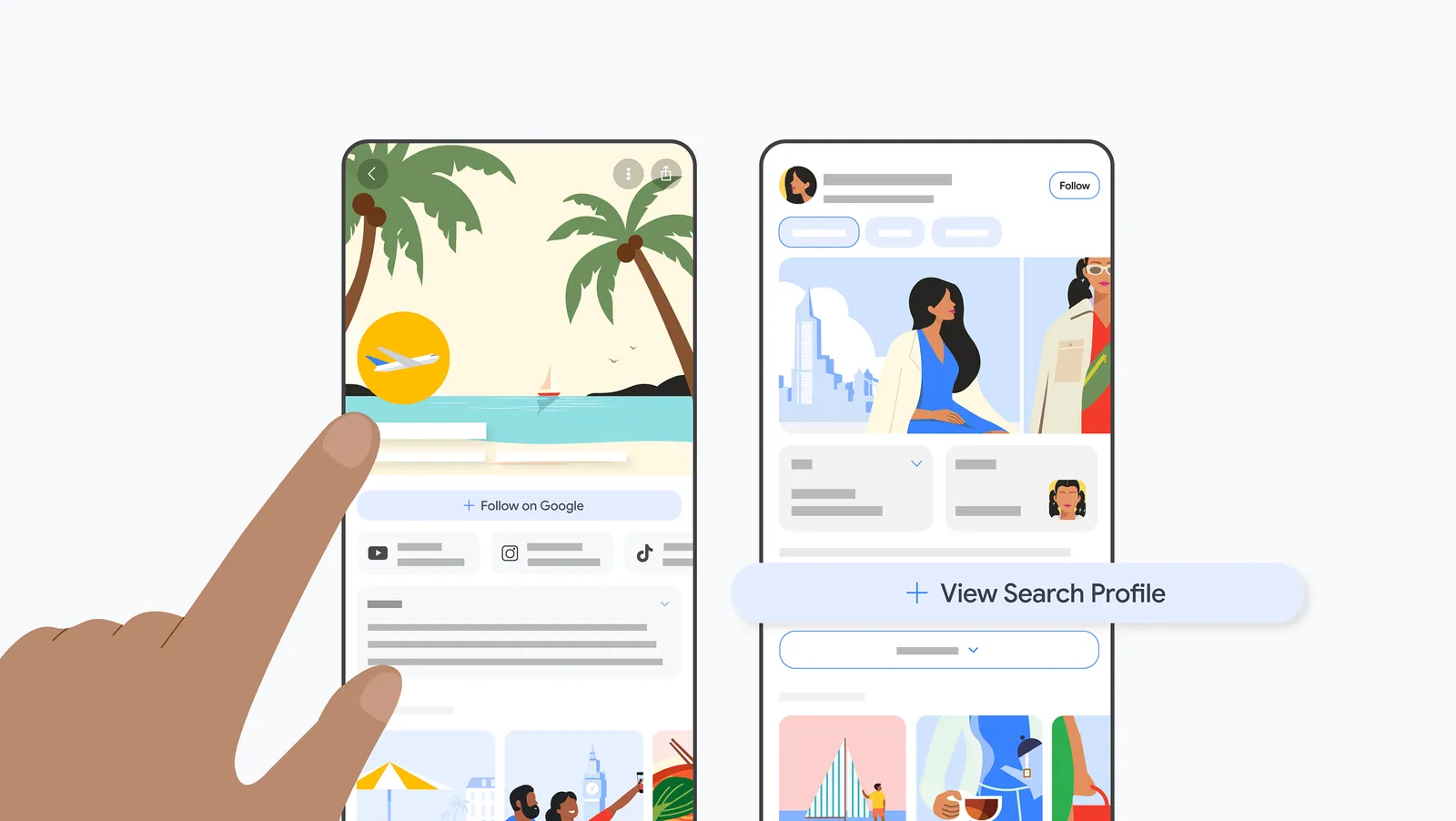
Source: Google, the new Search profile, aggregating a creator's content with a Follow button that feeds Discover.
Most coverage is treating this as a tidy product launch: here is a profile page, here is how to claim it. Accurate, but incomplete. The more interesting question is why this, why now, and our read is that Search profiles are part of something bigger. Facts first, then what we think is going on.
What are Google Search profiles?
A Search profile is a Google-hosted page that pulls together your latest articles, videos, and social posts in one place, alongside an avatar, bio, website link, and links to your social and video platforms. You claim and customize it; Google keeps the content feed updated automatically, so you don't maintain it post by post.
Those same accounts now get their own Search Console reporting, which we covered in platform properties. Adding an Instagram or TikTok account to Search Console takes about a minute per account.
The key mechanic is the Follow button. When someone follows you from your profile, Google makes your content "more likely" to appear in their Discover feed, which is measured in Search Console's Discover report. In other words, the profile isn't just a bio card. It's a subscription surface wired directly into Google's personalized content feed.
Here's what we think is actually happening
For twenty years the deal was straightforward: Google shows your blue link, the user clicks, you get a visitor. The click was the unit of distribution. That deal is breaking:
- AI Overviews answer the query on the results page, so the click never fires. Seer Interactive measured organic click-through rates down 61% on queries where AI Overviews appear.
- Google reports impressions, not clicks. As we covered in our breakdown of the new Search Console AI performance report, your AI impressions are visible and your clicks pointedly are not.
If Google kills the click, it needs a new way to send publishers an audience, or the open web it depends on starts to wall itself off. Our read: following is that replacement.
Instead of "rank for a query → earn a click," the new loop is "a user follows you → Google pushes your new content into their Discover feed." That is a different kind of distribution: recurring, relationship-based, and not re-litigated query by query. Search profiles are the on-ramp, the page where someone discovers you and taps Follow.
What we think is happening: from clicks to follows
Google is quietly swapping query-by-query clicks for a follow-based distribution loop
Classic SEO: earn a position on the results page.
The blue link is the unit of distribution.
One query, one click, one session.
The answer is now composed on the page, Seer Interactive measured organic CTR down 61% where AI Overviews appear. The click often never fires.
Via your knowledge panel, a direct URL, or your name in Discover.
A durable relationship, not a one-off query.
Your new content surfaces in their feed automatically.
Distribution becomes relationship-based and repeatable, no ranking required each time.
This is our read, not Google's stated position, but it's the simplest explanation for why a "profile page" ships the same season Google starts reporting AI impressions instead of clicks.
To be clear, this is our interpretation, not Google's stated position: Google describes Search profiles as a way to "help audiences find accurate and up-to-date information about sources." But the timing is hard to ignore. A follow-based distribution surface ships the same season Google starts reporting AI impressions instead of clicks.
Who is eligible for a Search profile?
This is where the launch gets narrow. Google says you need "a sizable following on at least one major social or video platform." Launch reporting puts concrete numbers on that bar:
Who qualifies for a Google Search profile
Follower thresholds reported at launch (June 2026)
Any one platform: You only need to clear the threshold on a single platform: not all of them.
18 or older: Creators must be at least 18 years old to claim a profile.
US only, for now: The launch is United States–only; Google says it will expand globally over time.
Google describes the bar as "a sizable following on at least one major social or video platform." The specific follower counts above are from launch reporting and may be tuned over time.
You only have to clear the threshold on one platform, and you must be 18 or older. The launch is US-only, though Google says it will "expand Search profiles to more publishers and creators around the world" over time. For most site owners it isn't available yet, which is why the strategy matters more than the feature.
How do you claim your Google Search profile?
If you clear the bar, claiming is quick. Go to profile.google.com/claim and sign in with the Google account you want the profile tied to, if you're a YouTube creator, Google recommends using the account connected to your channel.
How to claim your Google Search profile, step by step
From claim to distribution in four steps
Sign in with the Google account you want the profile tied to. YouTube creators should use the account connected to their channel.
Google checks your eligibility against your connected platforms: a sizable following on at least one (YouTube, Instagram, X, or TikTok) and age 18+.
Add an avatar, bio, website, and links to your social and video platforms. The profile then auto-aggregates your latest articles, videos, and posts.
Your profile appears via a direct URL, your knowledge panel, and your name in Discover: where users can Follow you to see your content in their feed.
Claiming a profile may also trigger a knowledge panel if you don't already have one, making this an entity-building move, not just a vanity page.
How do Search profiles connect to Discover and knowledge panels?
Three surfaces matter here, and they reinforce each other:
- Discover. The Follow button is the whole point. It routes your future content into followers' Discover feeds. If you've historically treated Discover as unpredictable, profiles give you a way to build a more durable Discover audience.
- Knowledge panels. Profiles surface through your knowledge panel, and claiming one may trigger the creation of a knowledge panel if you don't already have one. That makes claiming a profile an entity-building action. You're telling Google "this is a real, recognized source," not just decorating a page.
- A shareable URL. The profile has its own direct link you can promote off-platform, turning followers from anywhere into Discover subscribers.
Does this actually replace the traffic AI Overviews took?
Honestly: not yet, and not for most people. Search profiles are limited to large creators in the US, and a follow-based Discover loop is a slower, smaller channel than the open firehose of organic clicks it is nudging toward replacing.
Outlets covering the launch have framed it as arriving "amid consternation" over AI-driven traffic loss. It is reasonable to read this first version as a down payment on a new distribution model rather than a fix for the old one.
But dismissing it as a vanity page misses the direction of travel. Google is signaling that the entities it recognizes (sources with verified profiles, knowledge panels, and followers) are the ones it intends to keep distributing. That's a clue about where durable visibility comes from next, whether or not you can claim a profile today.
What should publishers and creators do now: even under 100K followers?
You can't claim a profile under the threshold, but you can build the foundations that make you the kind of recognizable, followable entity this whole system rewards. None of these require a six-figure following:
- Become a clean entity in Google's eyes. Implement
OrganizationandPerson/author schema, and usesameAsto connect your site to every social and video profile you own. This is the same signal a Search profile formalizes. Start sending it now. - Build real author authority (E-E-A-T). Named authors, credentials, consistent bylines, and author pages. Recognized people and brands are what knowledge panels, and profiles, are built on.
- Get Discover-ready technically. Discover is mobile-first and quality-sensitive: fast Core Web Vitals, large high-quality images, clean mobile rendering, and no intrusive interstitials.
- Grow a following you control on at least one platform. The eligibility bar is follower-based. The work you do to cross 100K on YouTube, Instagram, or X is the same work that unlocks the profile later.
A Search profile formalizes signals you can (and should) be sending already: clean Organization and author schema, connected sameAs links, and Discover-ready technical health. CrawlRaven's 200-Point Audit checks structured-data validity, author and entity markup, Core Web Vitals, and mobile health across your whole site. Start free: 1 site, no credit card.
Key Takeaways
- →What launched: Google Search profiles: a claimable, shareable page aggregating your articles, videos, and social posts, with a Follow button that feeds Discover. US-only, June 4, 2026.
- →Eligibility: A sizable following on at least one platform (reported as 100K on YouTube, Instagram, or X, or 300K on TikTok), and you must be 18+.
- →How to claim: profile.google.com/claim, signed in with the Google account tied to your channel. Claiming may also trigger a knowledge panel.
- →Our read: It ships the same season Google began reporting AI impressions instead of clicks. We think Google is shifting distribution from query-by-query clicks to a follow-based Discover loop, and profiles are the on-ramp.
- →If you're under the bar: You can't claim one yet, so build the entity foundations the system rewards: Organization/author schema, sameAs links, E-E-A-T, and Discover-ready technical health.
Primary sources used in this post
- Google: A new profile to help publishers and creators highlight their work on Search
- News from Google on X: Search profiles announcement
- Search Engine Journal: Search Profiles for creators with 100K followers
- Search Engine Land: Search profiles within Google Discover
- Variety: Search Profiles as AI summaries cause referral drop-off
Whatever a profile changes about your brand SERP shows up in your own Search Console data first, and seeing it means separating brand queries from everything else. The free GSC regex generator writes that filter as an RE2 pattern and tests it against sample queries before you paste it in.
Related reading on CrawlRaven
Frequently asked questions
What is a Google Search profile?
A Google Search profile is a claimable, shareable page that aggregates a publisher's or creator's latest articles, videos, and social posts, alongside an avatar, bio, website, and links to their social and video platforms. Audiences can follow you from the profile, which makes your content more likely to appear in their Google Discover feed. It surfaces via a direct URL, your knowledge panel in Search, and your name in Discover on mobile. Google launched it in the US on June 4, 2026.
Who is eligible for a Google Search profile?
Google requires a sizable following on at least one major social or video platform. Launch reporting puts the bar at roughly 100,000 followers on YouTube, Instagram, or X, or 300,000 on TikTok. You only need to clear the threshold on one platform, and you must be at least 18 years old. At launch the feature is available in the United States only.
How do I claim my Google Search profile?
Go to profile.google.com/claim and sign in with the Google account you want the profile tied to. If you're a YouTube creator, Google recommends using the account connected to your channel. Once verified, you can customize your avatar, bio, website, and platform links, and Google keeps your content feed updated automatically. Claiming a profile may also trigger the creation of a knowledge panel if you don't already have one.
How do Search profiles relate to Google Discover?
The Follow button is the core mechanic. When a user follows you from your Search profile, Google makes your future content more likely to appear in their Discover feed. This effectively turns the profile into a subscription surface wired into Google's personalized content feed, a way to build a more durable Discover audience rather than relying on one-off query rankings.
Why did Google launch Search profiles now?
Google says the goal is to help audiences find accurate, up-to-date information about sources. Our interpretation is that it's also part of a larger shift: as AI Overviews absorb clicks (Seer Interactive measured organic CTR down 61% where AI Overviews appear) and Google's new Search Console report shows AI impressions but not clicks, Google appears to be rebuilding publisher distribution around a follow-based Discover loop instead of query-by-query blue-link clicks. Search profiles are the on-ramp to that loop.
What can I do if I have fewer than 100K followers?
You can't claim a profile under the threshold yet, but you can build the same signals the system rewards: implement Organization and author (Person) schema with sameAs links to your social profiles, strengthen author authority and E-E-A-T, and get Discover-ready technically with fast Core Web Vitals, high-quality images, and clean mobile rendering. These are the foundations that make you a recognizable, followable entity, and they're auditable today.

Co-founder, CrawlRaven · 6+ years building SaaS content & SEO products
Ayush has 6+ years of experience building SaaS products and content strategies in the SEO space. As co-founder of CrawlRaven, he writes from hands-on experience building deep-crawl audit tools and solving the technical SEO problems agencies actually face.