Google May 2026 Core Update: Live Tracking, Volatility Data & Recovery Guide
Google's May 2026 Core Update started rolling out May 21 and is expected to complete by ~June 4. Live volatility data, verified primary-source quotes, the same-week-as-I/O recovery measurement problem, and a diagnostic flowchart for site owners.
Google's May 2026 Core Update went live on May 21, 2026 at ~08:43 PDT, two days after Google I/O 2026 (May 19–20). Rollout is expected to take up to two weeks, with estimated completion around June 4. Two things make it harder to read than a typical core update:
- This is the second core update of 2026, after the March 27–April 8 rollout. Measured start-to-start the gap is just 7.9 weeks: the fastest 2026 cadence, second only to the unusual back-to-back November → December 2024 sequence.
- Recovery measurement is complicated by Google I/O 2026, which expanded Generative UI and AI Mode surfaces, meaning a page that kept its rank on AI-eligible queries can still see less click traffic from layout absorption.
- Volatility tools flagged a major pre-rollout spike on May 13–14, eight days before the official rollout, PPC Land reported at least one publisher site losing nearly all of its index coverage during that window.
Semrush Sensor shows the All-Categories score at 0.7/10 (Low) on May 24, with a clear spike to ~9 in the May 19–20 window. Glenn Gabe reports on May 23 that 'this update looks like it's landing already.' Google called it 'a regular update designed to better surface relevant, satisfying content': no new guidance, no companion blog post.
Google's May 2026 Core Update went live on May 21 at ~08:43 PDT, 36 hours after I/O 2026. Two complications: the simultaneous I/O AI Mode and Generative UI changes mean rank can hold while clicks drop, and 12 volatility tools flagged a spike on May 13–14, eight days early. Try CrawlRaven free: 1 site, no credit card →
Google's May 2026 Core Update went live on May 21, 2026 at ~08:43 PDT, just 36 hours after the I/O 2026 keynote. The rollout should take up to two weeks, putting completion at ~June 4, 2026. As of writing (May 23, Day 3) it is still going, and three things about it are being underplayed.
- Recovery measurement is structurally complicated this rollout. Because AI Overviews + AI Mode (launched at I/O 2026) are simultaneously changing CTR on the same rankings, a page that kept its rank can still see less click traffic. Standard "wait for recovery" advice doesn't cleanly translate.
- Pre-rollout volatility on May 13–14 was unusual. Eight days before the official rollout, 12 volatility tools flagged a major spike, and PPC Land reported at least one publisher site losing nearly all of its index coverage during that window. Google didn't confirm an update at the time; we're flagging the timing, not asserting a cause. The same pattern repeated in August, and we wrote up how to diagnose ranking volatility Google never confirmed as a standalone method.
Below is what we've verified from primary sources (Google Search Status Dashboard, official @googlesearchc posts, Search Engine Roundtable, Search Engine Journal, PPC Land), the live volatility picture, what verified-by-name SEOs are saying, and a 4-question diagnostic to figure out whether your traffic move was the core update or the I/O 2026 changes.
The May 2026 Core Update, full timeline
Pre-rollout volatility → I/O 2026 → rollout start → community signals → expected completion
12 volatility tools (Semrush, SimilarWeb, AWR, Sistrix, Wincher, Zutrix, AccuRanker, Mozcast, DataForSEO, SERPstat, Algoroo, Wiredboard) flag an unusual spike. PPC Land reports one publisher site losing nearly all of its index coverage during the window.
Intelligent Search Box, Gemini 3.5 Flash as default AI Mode model, Information Agents, Generative UI, and AI Overviews unification announced. Recovery measurement is now structurally tangled with these rollouts.
Google logs the rollout on the Search Status Dashboard and announces via @googlesearchc on X. "The rollout may take up to 2 weeks to complete."
Day-2 community reaction: "This update will classify all non-Google websites as spam." 34.4K views. Sentiment signal for how publishers feel post-I/O.
Detailed early observations on r/SEO sentiment: health/medical swinging hard, forums moving, reference + lyrics sites moving. Mixed signals on sites using risky tactics for AI Search visibility.
Based on Google's stated "up to 2 weeks" timeline. No firm confirmation; Google has not historically published rollout completion announcements promptly.
What Google actually said about the May 2026 Core Update
Google's announcement language is the leanest it's been for any core update in years. The official rollout dashboard entry reads:
"Released the May 2026 core update. The rollout may take up to 2 weeks to complete."
– Google Search Status Dashboard, May 21, 2026
On the official X account, the language was:
"Today we released the May 2026 core update. We'll update our ranking release history page when the rollout is complete."
– @googlesearchc, May 21, 2026, ~08:43 PDT (quoted by Search Engine Journal)
Search Engine Journal also reports that Google described it as "a regular update designed to better surface relevant, satisfying content for searchers from all types of sites." That phrase has been Google's standard framing across multiple recent core updates. There is no new guidance specifically tied to this rollout.
No companion blog post. No new ranking systems disclosed. Search Engine Journal and PPC Land both note the absence of detailed disclosure, consistent with Google's lighter communication pattern across 2026 core updates.
Why the cadence matters: the fastest 2026 cadence
Two ways to measure the gap, and both are unusually short:
- Start-to-start: 7.9 weeks. From the March 27 start of the previous core update to the May 21 start of this one.
- Completion-to-start: 43 days (6.1 weeks). From the April 8 completion to the May 21 launch.
Setting aside the unusual back-to-back November → December 2024 sequence, which ran roughly 4 weeks apart, May 2026 is the fastest cadence between core updates in two years.
Core update cadence: gap between successive update starts
Weeks between start dates · Aug 2024 → May 2026
Aug 15, 2024 → Nov 11, 2024
Nov 11, 2024 → Dec 12, 2024, unusually short back-to-back
Dec 12, 2024 → Mar 13, 2025
Mar 13, 2025 → Jun 30, 2025
Jun 30, 2025 → Dec 11, 2025
Dec 11, 2025 → Mar 27, 2026
Mar 27, 2026 → May 21, 2026, fastest 2026 cadence
Start dates from Google's Search Status Dashboard and Search Engine Land's rollout-completion reports. Excluding the unusual Nov → Dec 2024 back-to-back sequence, May 2026 is the fastest cadence in 2 years.
Practical consequence: many sites hit by the March 2026 rollout were still mid-recovery. Google's standard advice is to "keep doing the work and wait for the next core update to reassess", and that next one arrived before the work could compound. Our March 2026 analysis has the recovery framework, on a tighter timeline.
Volatility data: what the SERPs are actually doing
Three days into the rollout, the volatility picture is more nuanced than the "massive shake-up" framing some trade outlets are using. The biggest pre-update volatility happened a full week before the rollout was announced, and day-of disruption has been modest by historical standards.
Semrush Sensor: All Categories, US Desktop (May 24, 2026)
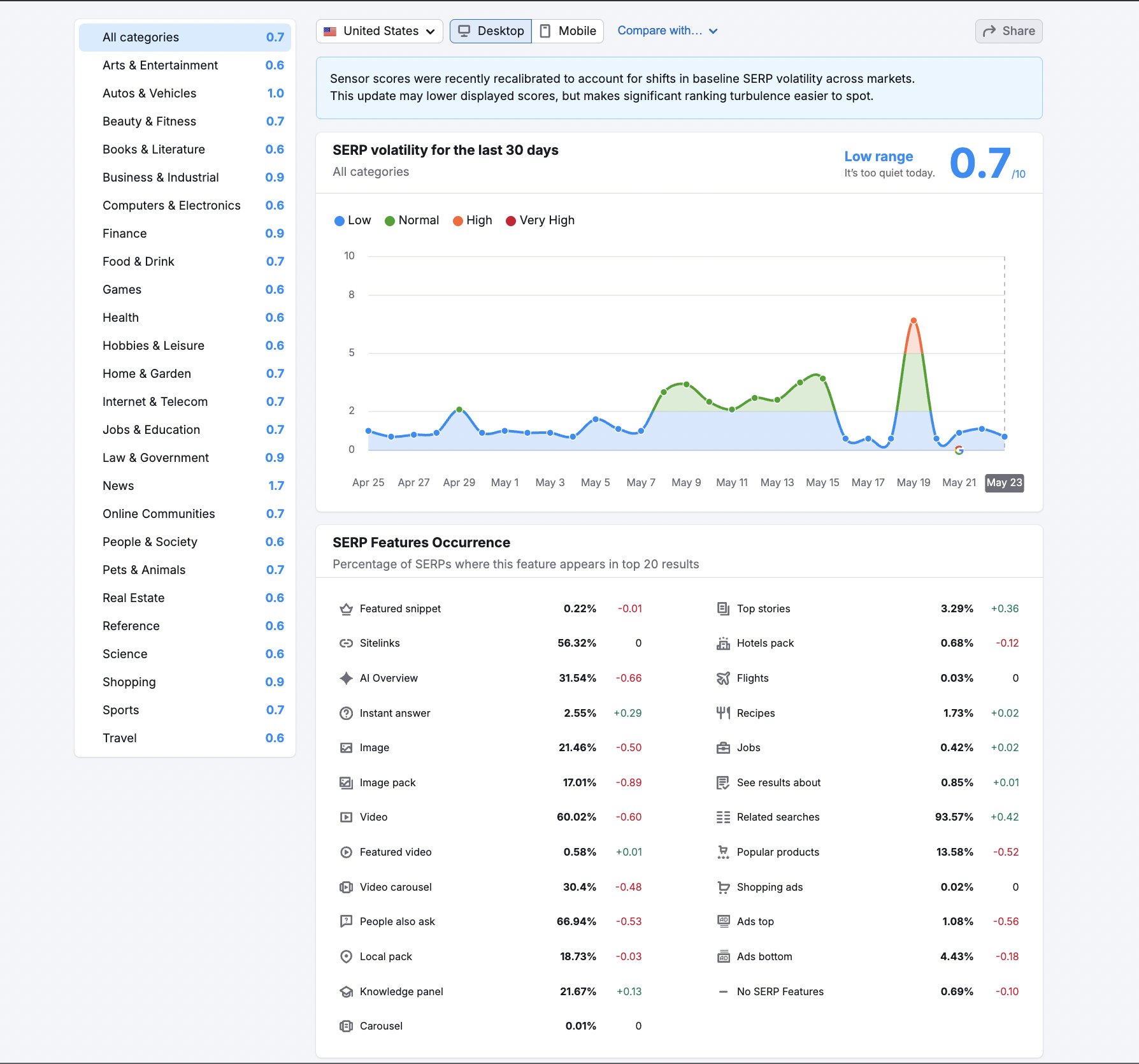
Snapshot at May 24, 2026. All Categories US Desktop score is 0.7 / 10 ("Low range"). The 30-day chart shows a clear, sharp spike to ~9 around May 19–20 (the I/O 2026 announcement window), then a sharp drop. By Day 3 of the rollout, the standard SERP volatility is unusually low.
Category breakdown shows Autos & Vehicles highest at 1.0, with most other categories sitting in the 0.5–0.7 range. There's no single "rocked category" story to tell from Semrush yet. The volatility is broadly distributed and modest.
The May 13–14 pre-rollout spike
A full eight days before the official announcement, PPC Land reported a coordinated volatility spike across 12 tools: Semrush, SimilarWeb, Advanced Web Rankings, Sistrix, Wincher, Zutrix, AccuRanker, Mozcast, DataForSEO, SERPstat, Algoroo, and Wiredboard's aggregator.
- Sistrix. Barry Schwartz characterized the reading as showing "extreme fluctuations."
- SimilarWeb. Described in the same reporting as "wild."
- One site owner's report. Virtually everything gone from the index except the root page, on a property that had previously generated 30,000–35,000 daily clicks at over 10% CTR.
At the time, Google declined to confirm a named update. With the May 21 rollout now public, one plausible reading is that some of the May 13–14 movement was connected to pre-rollout ranking changes Google had not yet announced.
Google's communications did not address the connection. We are flagging it as a pattern, not a confirmed cause.
Why recovery measurement is structurally complicated this rollout
This is the most under-covered angle. The standard core update playbook says: see how your rankings move, identify affected pages, improve quality, and wait for the next core update to recover. That playbook assumes rank → traffic is a stable mapping. After I/O 2026, it's not.
Why recovery measurement is structurally complicated this rollout
Two simultaneous signals, ranking changes + AI Mode CTR shifts, are tangled in the same data
Rank-to-traffic was a relatively stable mapping. A rank improvement translated to a predictable click lift.
Google announces expanded Generative UI, AI Mode, and AI Overviews surfaces. Layout shifts on many queries (broad / informational / comparative).
May 21, 08:43 PDT, Google releases the May 2026 Core Update. Rollout runs up to 14 days alongside the new AI surfaces.
On AI-Mode-eligible queries, the same rank now sits alongside a generated layout that may absorb the click before it reaches your link. The rank → traffic mapping is no longer reliable for those queries, making it harder to read the core update's actual effect on quality signals.
The disambiguation method: in Search Console, segment by AI-Mode-eligible vs non-eligible queries. The non-eligible bucket isolates the core update signal cleanly.
At I/O 2026, Google announced an expanded Generative UI surface (full-page generated layouts for AI-Mode-eligible queries) and continued expansion of AI Overviews. Our I/O 2026 breakdown covers the mechanics.
- The practical SEO consequence. On broad, conversational or comparison-heavy queries, the ones most likely to trigger AI Mode or AI Overviews, the path from rank to click is no longer a stable mapping.
- Nobody can quantify it yet. Observers including Glenn Gabe have flagged this as the harder-to-measure side of the rollout, and Google has not published query-share or CTR data.
The disambiguation method that works: open Search Console and segment queries by intent.
- Non-eligible queries (navigational, brand, exact transactional). This is where the May 2026 Core Update signal is cleanest.
- AI-Mode-eligible queries (broad, informational, comparative, how-to). This bucket mixes ranking and AI layout effects, so read relative movement rather than absolute traffic.
How to tell if you were hit by the May 2026 Core Update
Was it the May 2026 Core Update or I/O 2026 AI changes?
A 4-question diagnostic for site owners trying to disambiguate two simultaneous signals
Likely involves the May 2026 Core Update
Look at pre-rollout volatility (May 13–14) or older causes, not this update
Layout shift from I/O 2026 (AI Overviews / AI Mode) may be a contributing factor, segment in Search Console to isolate
Drop is more likely core-update-driven on its own
If rank moved: core update signal. If rank held but clicks dropped: more likely AI layout absorption.
–
Technical regression. Fix those first, then re-evaluate after rollout completes (~June 4)
Content / quality signal, Google's recovery guidance applies
Four practical steps to disentangle the signals:
- Check the dates. If your traffic drop started on or after May 21, the core update is in scope. If it started May 13–14, you're looking at the pre-rollout volatility, different problem.
- Pull Search Console: last 7 days vs prior 7 days. Compare Impressions, Clicks, and Position separately. If Position is stable but Clicks dropped, the cause is likely an AI layout shift (AI Overviews / AI Mode absorbing the click) rather than a core update demotion of the page itself.
- Segment by query type. The cleanest core-update signal is in non-AI-Mode-eligible queries. Brand queries, exact-match transactional terms, and navigational queries all isolate the ranking change.
- Run a technical baseline. A core update demotion is by definition a quality signal, but you can't tell that until you've ruled out a recent technical regression. A CrawlRaven crawl on your top 20 affected URLs against the last clean baseline tells you in 10 minutes whether the page actually changed. If technical health is identical, the hit is content/quality-driven and Google's recovery guidance applies.
What the SEO community is saying about the May 2026 Core Update
Three days in, the named-and-verified community reactions divide into two camps: "this update is landing already and we're seeing the moves" and "publishers are tired of this whole pattern." Both perspectives are valid; we include the verified ones below.
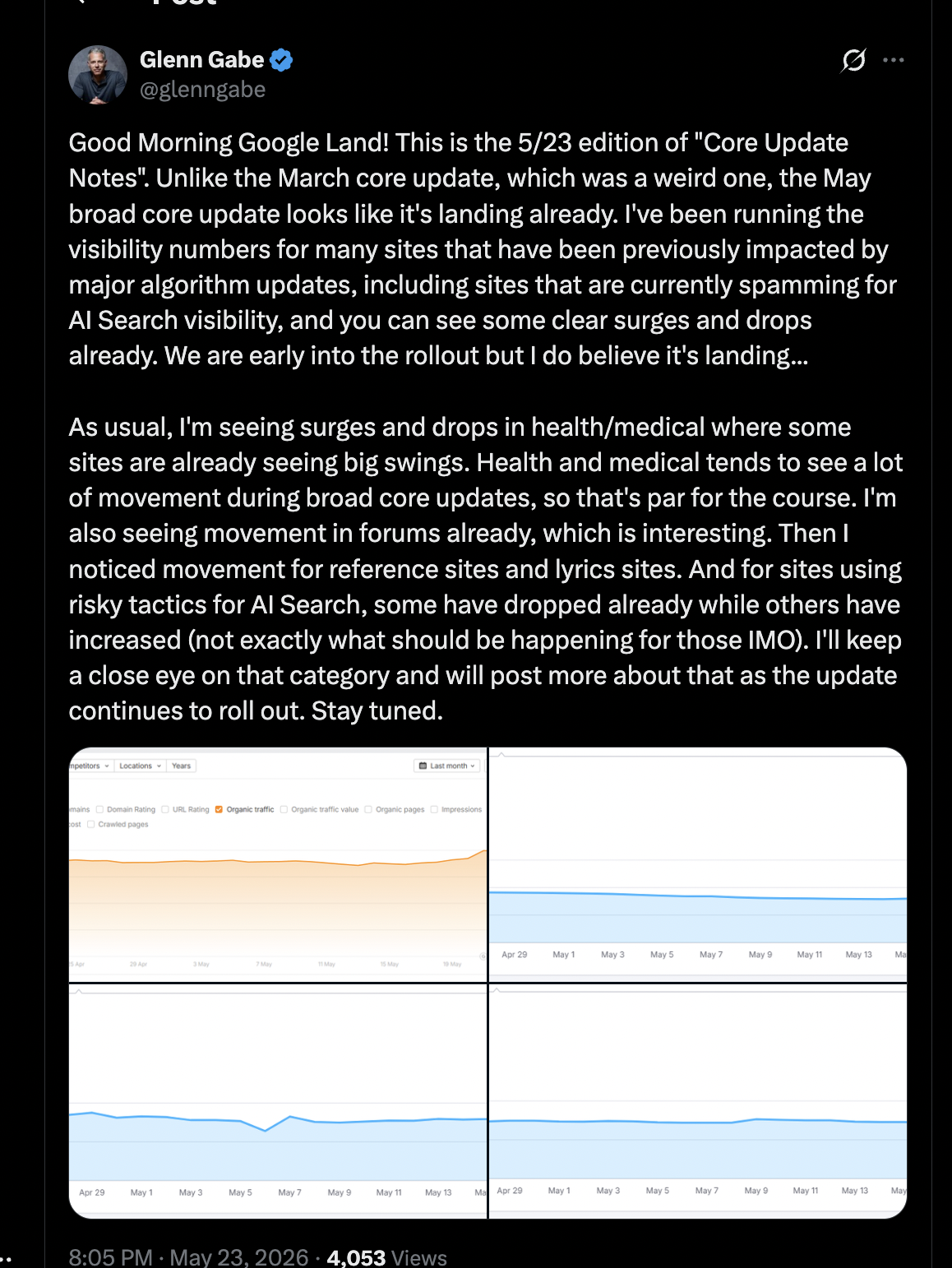
Glenn Gabe: "It's landing already" (May 23, 2026)
Glenn Gabe's May 23 post on X, the most substantive day-by-day analysis we've found in the first 72 hours, calls the May update "not weird" in contrast to March:
"Unlike the March core update, which was a weird one, the May broad core update looks like it's landing already.
I've been running the visibility numbers for many sites that have been previously impacted by major algorithm updates, including sites that are currently spamming for AI Search visibility, and you can see some clear surges and drops already. We are early into the rollout but I do believe it's landing..."
– @glenngabe on X, May 23, 2026 (8:05 PM, 4,053 views)
Gabe's specific category observations from that thread:
- Health and medical: surges and drops, "tends to see a lot of movement during broad core updates, so that's par for the course."
- Forums: movement, "which is interesting"
- Reference sites and lyrics sites: movement noted
- Sites using risky tactics for AI Search visibility: "some have dropped already while others have increased (not exactly what should be happening for those IMO)"
That last bullet is the most consequential. If sites gaming AI Search visibility are gaining, the new core algorithm isn't yet penalizing those signals reliably. Expect Google to tune that across the rollout window.
Cyrus Shepard: the satirical sentiment-check (May 22, 2026)
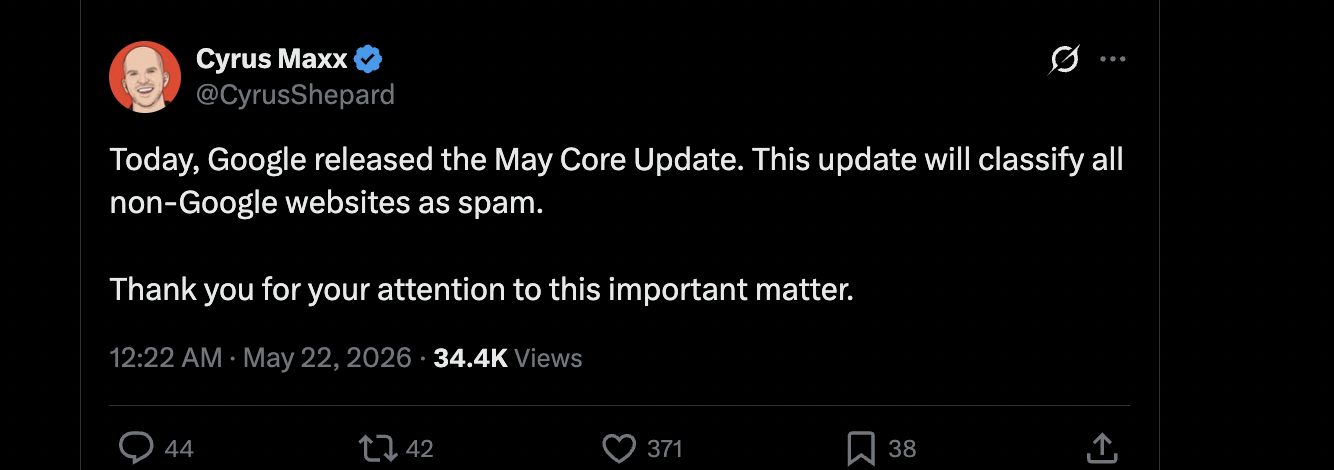
Cyrus Shepard's viral 34.4K-view post on May 22 is satirical, but the engagement (44 replies, 42 reposts, 371 likes) signals where SEO sentiment sits three days into the rollout. The takeaway: publisher trust is eroded by the combination of I/O 2026 changes and the second core update of the year.
"Today, Google released the May Core Update. This update will classify all non-Google websites as spam."
"Thank you for your attention to this important matter."
– @CyrusShepard on X, May 22, 2026 (12:22 AM, 34.4K views)
Search Engine Roundtable: the canonical trade recap
Barry Schwartz's May 2026 Core Update recap on Search Engine Roundtable is the canonical day-of post. Worth bookmarking for the day-by-day updates as he tracks the rollout. SER and Search Engine Land are the two outlets we'd watch for completion confirmation.
Winners and losers: what's reported, what's speculation
We're going to be honest about a Day-3 caveat here: in the first 72 hours of a 14-day rollout, winner/loser lists are extrapolation, not confirmation. Several trade outlets are recycling category-level patterns from the March 2026 rollout. We're labelling those clearly.
Reported early-rollout patterns (per Glenn Gabe's May 23 analysis + trade press extrapolation):
- Health and medical sites: heavy movement both directions (typical for core updates)
- Forums and community sites: meaningful movement (notable, this is a 2026 shift)
- Reference sites and lyrics sites: movement reported
- Sites optimizing aggressively for AI Search visibility: mixed signals; some gaining, some losing, which is itself a signal that this dimension isn't fully tuned in the May algorithm
Carried over from March 2026 rollout coverage (treat as background, not May 2026 measurements):
- Aggregators and thin comparison pages: historically lose
- Generic affiliate content with no first-party input, historically lose
- Government, nonprofit, association domains: historically gain
- Sites with named authors and verifiable credentials, historically gain
- Pages with original data, case studies, first-hand experience: historically gain
We'll update this section as concrete May 2026 winner/loser data emerges from the trade press. For now, the most defensible move is to wait for the rollout to complete (~June 4) before drawing site-specific conclusions.
Recovery guide for the May 2026 Core Update
Google's official recovery guidance reduces to make satisfying content meant for people. The framing has been substantively unchanged across recent core updates. That's not unhelpful, but it's also not actionable. Here's the practical sequence we'd run if our agency was managing a hit client today:
- Wait until the rollout completes (~June 4). Acting on partial signal during a multi-week rollout produces noisy decisions. Document what moved, but don't re-write yet.
- Run a CrawlRaven baseline on your top 50 affected URLs. Compare against your most recent pre-May 13 crawl. Rule out technical regressions before assuming content/quality cause.
- Segment Search Console by query type. Separate AI-Mode-eligible queries from non-eligible ones. The non-eligible bucket is where you measure the actual core update signal.
- Identify your specific quality dimension. Core updates target one or more E-E-A-T dimensions. Look at your demoted pages and identify the common gap: credentials, first-hand experience, originality, navigability, ad density, content depth.
- Fix the dimension, not the individual page. If experience is the gap, your entire content production process needs to change, adding an author bio to one page doesn't recover the site.
- Wait for the next core update for recovery measurement. Per Google's standing guidance, page-level recoveries within the same rollout are rare. Plan for a multi-month rebuild.
- Don't panic on AI Mode CTR loss. If your ranks held but clicks dropped, that's a layout problem, not a quality problem. Optimizing schema, snippet copy, and surface formatting matters more than rewriting the page.
For the deeper recovery playbook, including the 8-step framework we used at our agency for prior core updates, read our March 2026 Core Update recovery guide. The recovery process is unchanged; the measurement layer is what's new.
What this means if you ship SEO for a living
Two takeaways we'd pin to a Slack channel right now:
- Disambiguating two signals at once is the actual job. Sites that "recovered" from March 2026 in non-AI queries can still look broken in aggregate because of AI Mode CTR shifts. Build the segmentation habit now.
- The cadence is faster. Six weeks between core updates is fast: plan content quality work in two-month sprints, not quarter-long ones, and don't assume the next gap will be longer.
Core updates are settled on individual pages, not on sites, which makes the page-level checks worth running before you rewrite anything. The free readability checker scores how hard a page is to finish and the page word counter separates body copy from navigation, which is the number thin-content decisions should be made on.
How this article was researched
We're an SEO audit tool team (CrawlRaven), with prior agency experience. The first-person framing, and the specific recovery playbook, comes from that. The facts in this article come from:
- Primary Google sources: Search Status Dashboard, ranking updates page, the @googlesearchc X and LinkedIn posts.
- Trade outlets: Search Engine Roundtable, Search Engine Land, Search Engine Journal, PPC Land.
- Verified community posts: Glenn Gabe on X (May 23, 2026, embedded above), Cyrus Shepard on X (May 22, 2026, embedded above).
- Live volatility data: Semrush Sensor on May 24, 2026 (screenshot embedded above).
All quotes are verbatim. All dates are from primary sources. This page will be updated as the rollout progresses.
Related reading
Frequently asked questions
When did the Google May 2026 Core Update start?
Google announced the May 2026 Core Update on May 21, 2026 at approximately 08:43 PDT (11:43 AM ET). The announcement first appeared on Google's official LinkedIn account, then on X via @googlesearchc, and then on the Google Search Status Dashboard. The rollout is expected to take up to two weeks, putting estimated completion at approximately June 4, 2026.
Has the May 2026 Core Update finished rolling out?
No. As of May 23, 2026 (Day 3 of the rollout), Google has not declared the update complete. The official statement is 'the rollout may take up to 2 weeks to complete.' Estimated completion is around June 4, 2026, though Google does not always announce completion immediately. Watch the Google Search Status Dashboard and Search Engine Roundtable for confirmation.
Is the May 2026 Core Update different from previous core updates?
Two things are notably different. (1) Recovery measurement is harder this rollout because Google I/O 2026 (May 19–20) introduced expanded Generative UI and AI Mode surfaces that change layout, and click-through behavior, on the same set of queries. A page that kept its rank can still see less click traffic on AI-eligible queries, which makes the core update's quality signal harder to isolate. (2) The cadence is the fastest of 2026: just under 8 weeks between the March 27 start and the May 21 start, or about 6 weeks measured from the April 8 completion of the March update.
What is the connection to Google I/O 2026?
Google's I/O 2026 keynote (May 19–20) introduced the Intelligent Search Box, Gemini 3.5 Flash as the default AI Mode model, Information Agents, and Generative UI: all of which expand how AI-generated layouts appear on Search. The May 2026 Core Update went live 36 hours later, on May 21. The overlap means many sites are experiencing two simultaneous signals: ranking changes from the core update and layout/CTR changes from the AI surfaces. To diagnose, segment Search Console queries by AI-Mode-eligible vs non-eligible, the non-eligible bucket isolates the core update signal more cleanly.
What does Semrush Sensor show for the May 2026 Core Update?
As of May 24, 2026, Semrush Sensor shows an All Categories US Desktop volatility score of 0.7 / 10 ('Low range'). The 30-day chart shows a clear, sharp spike to approximately 9/10 during May 19–20 (the I/O 2026 window). By Day 3 of the rollout, standard SERP volatility has dropped back to a low range. Category breakdown shows Autos & Vehicles highest at 1.0, with most other categories sitting in the 0.5–0.7 range. There is no single high-volatility category in this rollout.
Was there volatility before the May 2026 Core Update started?
Yes. A major pre-rollout spike on May 13–14, 2026, eight days before the official announcement. PPC Land reported that 12 volatility tools (Semrush, SimilarWeb, Advanced Web Rankings, Sistrix, Wincher, Zutrix, AccuRanker, Mozcast, DataForSEO, SERPstat, Algoroo, Wiredboard) flagged the spike. In PPC Land's reporting, Barry Schwartz characterized the Sistrix reading as showing 'extreme fluctuations,' and the SimilarWeb reading was described as 'wild.' One publisher reported losing nearly all of their index coverage during that window: previously a property generating 30,000–35,000 daily clicks. Google didn't confirm a named update at the time; we're flagging the timing, not asserting a cause.
What did Glenn Gabe say about the May 2026 Core Update?
Glenn Gabe posted on X on May 23, 2026 (8:05 PM): 'Unlike the March core update, which was a weird one, the May broad core update looks like it's landing already.' He reported specific category movements: health and medical seeing big swings, forums moving (which he called interesting), reference sites and lyrics sites moving, and sites using risky tactics for AI Search visibility showing mixed signals, some dropping, some increasing. The mixed AI-Search-visibility signal suggests the new core algorithm hasn't yet fully tuned that dimension.
How do I know if I was hit by the May 2026 Core Update?
Run this 4-question diagnostic: (1) Did your traffic drop start on or after May 21? If yes, the core update is in scope. (2) Are the dropped queries AI-Mode-eligible (broad, conversational, comparative)? If yes, layout shift from I/O 2026 AI surfaces may be a contributing factor, segment Search Console to isolate. (3) Did your rank actually move, or did the page hold rank but lose clicks? Rank movement points to a core update signal; same rank with fewer clicks points to AI layout absorption. (4) Did a technical crawl show new technical issues? If yes, fix those first; if no, the hit is more likely content/quality-driven.
How do I recover from the May 2026 Core Update?
Wait until the rollout completes (~June 4) before making big changes, partial signal produces noisy decisions. Then: (1) Run a technical baseline crawl on your top 50 affected URLs to rule out regressions. (2) Segment Search Console by AI-Mode-eligible vs non-eligible queries to isolate the core update signal. (3) Identify the specific quality dimension Google is targeting (E-E-A-T: credentials, first-hand experience, originality, ad density, content depth). (4) Fix the dimension across your entire content production process, not page by page. (5) Wait for the next core update for recovery measurement. Google's standing recovery framing, make satisfying content meant for people, has been substantively unchanged across recent core updates.
Is the helpful content system (HCU) involved in the May 2026 update?
Google folded the Helpful Content System into the core algorithm with the March 2024 core update. There is no standalone HCU signal in 2026. It's now part of the core algorithm's normal operation. The May 2026 Core Update does not introduce any disclosed new HCU-specific signal changes. Recovery patterns from the original HCU rollouts still apply: improve quality, depth, experience, and credentials, and wait for the next core update to reassess.
What's the difference between the March 2026 and May 2026 Core Updates?
Two main differences. (1) Cadence: The May update arrived just 6 weeks after the March update completed (April 8), which is the shortest gap since 2024. (2) Co-rollout context: The May update launched 36 hours after Google I/O 2026, which simultaneously rolled out AI Mode + Generative UI changes, so traffic moves are tangled with AI behavior shifts, not just ranking changes. According to Glenn Gabe's May 23 analysis, the May update 'looks like it's landing already' (i.e., showing clear ranking moves), unlike the March update which he characterized as 'a weird one.'

Co-founder, CrawlRaven · 6+ years building SaaS content & SEO products
Ayush has 6+ years of experience building SaaS products and content strategies in the SEO space. As co-founder of CrawlRaven, he writes from hands-on experience building deep-crawl audit tools and solving the technical SEO problems agencies actually face.