Ahrefs Review 2026: Pricing, Features & Honest Verdict
An honest Ahrefs review with every 2026 plan priced (Starter $29 to Enterprise $1,499/mo, verified July 2026), a plain-English breakdown of how Ahrefs credits work and how fast they run out, backlink analysis strengths, site audit limitations, and better alternatives for technical SEO auditing.

Ahrefs is the industry leader for backlink analysis and keyword research, scoring 4.5/5 on G2.
- Pricing (verified July 2026): $29/month for a severely limited 200-credit Starter plan, $129/month for Lite, up to $1,499/month for Enterprise.
- The credit trap: every report view and filter change costs a credit on Starter and Lite, so exploratory research is effectively metered until the $249/month Standard tier.
- Site audit: a bolt-on module, which makes Ahrefs a poor fit if technical SEO auditing is your primary need.
For dedicated site auditing with prioritized fixes, CrawlRaven ($49 at launch) or Screaming Frog ($279/year) deliver deeper crawls at lower cost.
Ahrefs dominates backlink analysis and keyword research. What it does not do is tell you which of your pages to act on. CrawlRaven imports that export, joins it to your Search Console data and a 200-point crawl, and returns a ranked plan. Starts free, lifetime licenses from $49 at launch. Try CrawlRaven free: 1 site, no credit card →
Ahrefs is the industry leader for backlink analysis and keyword research, with the largest commercial backlink index (35T+ links) and one of the deepest keyword databases available. Plans start at $29/month (Starter), but the useful features begin at $129/month (Lite).
- Backlink data: best-in-class.
- Keyword difficulty scores: accurate.
- Content Explorer: the tool for finding link-worthy content.
- Credit-based pricing: runs out fast.
- Site audit: a bolt-on module, not a dedicated crawler.
- Cost at scale: expensive.
Ahrefs Review Verdict: 4.0 / 5
Ahrefs is the best backlink analysis tool on the market in 2026, with the second-largest web crawler after Google and an index of 35+ trillion external backlinks. Its keyword research, content explorer and competitor analysis are genuinely world-class.
The credit-based pricing system frustrates users at every tier, though, and the site audit module is a bolt-on that cannot match dedicated auditing platforms.
Agencies and mid-to-large businesses focused on backlink intelligence, competitor research, and keyword discovery
You primarily need deep technical site auditing, white-label reports, or a budget-friendly all-in-one SEO tool
| Category | Ahrefs Rating | Key Detail |
|---|---|---|
| Backlink Analysis | ★★★★★ 5/5 | Largest commercial backlink index (35T+ links) |
| Keyword Research | ★★★★☆ 4/5 | 10+ search engines, unique Traffic Potential metric |
| Site Audit | ★★★☆☆ 3/5 | Credit-based, limited customization vs. dedicated crawlers |
| Pricing Value | ★★★☆☆ 3/5 | $29 Starter is restrictive; $129 Lite minimum for real work |
| Ease of Use | ★★★★☆ 4/5 | Clean UI praised across reviews, moderate learning curve |
“Best backlink index in the industry. The data depth is unmatched by any competitor.”
★★★★★G2
“Keyword Explorer and Content Explorer are incredibly powerful for finding content opportunities.”
★★★★★Capterra
“The credit system is frustrating. You run out fast and have to upgrade or wait.”
★★★★★G2
“Site Audit is too basic compared to dedicated crawlers. It misses a lot of issues.”
★★★★★G2
“Pricing is absurd for small teams. The Starter plan is severely limited.”
★★★★★Trustpilot
Ahrefs Feature Scorecard
How each capability stacks up, rated 1 to 5
Largest commercial index: 35T+ external backlinks
10+ search engines, unique Traffic Potential metric
Clean UI, moderate learning curve, 4.5/5 on Capterra
Bolt-on module, lacks custom extraction, log analysis
Credit system frustrates users; $129/mo minimum for real work
Ahrefs key features: what the platform does in 2026
Ahrefs has six core tools: Site Explorer, Keywords Explorer, Site Audit, Rank Tracker, Content Explorer, and a backlink index. Plans start at $129/month (Lite). Here is what each tool does and where its limits are.
Site Explorer: domain and URL-level analysis
Site Explorer is Ahrefs' flagship tool and the entry point for most users. You enter any domain or URL and get a comprehensive overview of its organic search performance and backlink profile.
- Dashboard overview: Shows estimated organic traffic, ranking keywords, referring domains, and a traffic value estimate (what that organic traffic would cost via Google Ads)
- Analysis scopes: Toggle between domain-level, subdomain, exact URL, and URL prefix analysis for different data granularity
- Organic keywords report: Displays every keyword a domain ranks for in Google's top 100 results, with columns for position, search volume, traffic estimate, keyword difficulty, CPC, SERP features, and ranking URL
- Historical data: Goes back several years, letting you chart ranking trends for specific keywords or see when a domain gained or lost visibility after an algorithm update
- Traffic share by domain: Shows which competitors share the same keyword landscape
- Top Pages view: Ranks every page on a domain by estimated organic traffic so you can identify a competitor's highest-performing content assets
- Paid Keywords report: Reveals competitor Google Ads campaigns, keywords they bid on, ad copy, and estimated ad spend
- Pages report: Surfaces historical traffic trends per URL, letting you pinpoint which specific pages drove a domain's growth or decline
Keywords Explorer: keyword research across 10+ search engines
Keywords Explorer is Ahrefs' dedicated keyword research tool, covering Google, YouTube, Bing, Amazon, Yahoo, Yandex, Baidu, Naver, Daum, and several other search engines: making it one of the broadest keyword research tools available for international SEO teams.
- Core metrics: Enter a seed keyword (or up to 10,000 in batch mode) and receive search volume, keyword difficulty (KD), click-through rate data, cost-per-click estimates, and a Traffic Potential metric unique to Ahrefs
- Traffic Potential: Estimates total organic traffic the top-ranking page receives from all keyword variations, not just the single query you entered, giving a more realistic picture of what ranking for a topic could deliver
- Keyword ideas: "Matching terms" returns keywords containing your seed phrase, "Related terms" returns semantically connected keywords, and "Search suggestions" pulls autocomplete data directly from each search engine
- Filtering: Apply filters for volume range, difficulty range, word count, include/exclude terms, and SERP features
- Parent Topic grouping: Clusters keyword variants under a single umbrella topic, helping avoid duplicate content targeting keywords that Google treats as the same query
- SERP overview: Shows the top 10 ranking pages with their DR, UR, backlinks, referring domains, traffic, and word count: giving a complete picture of what it takes to compete for any given term
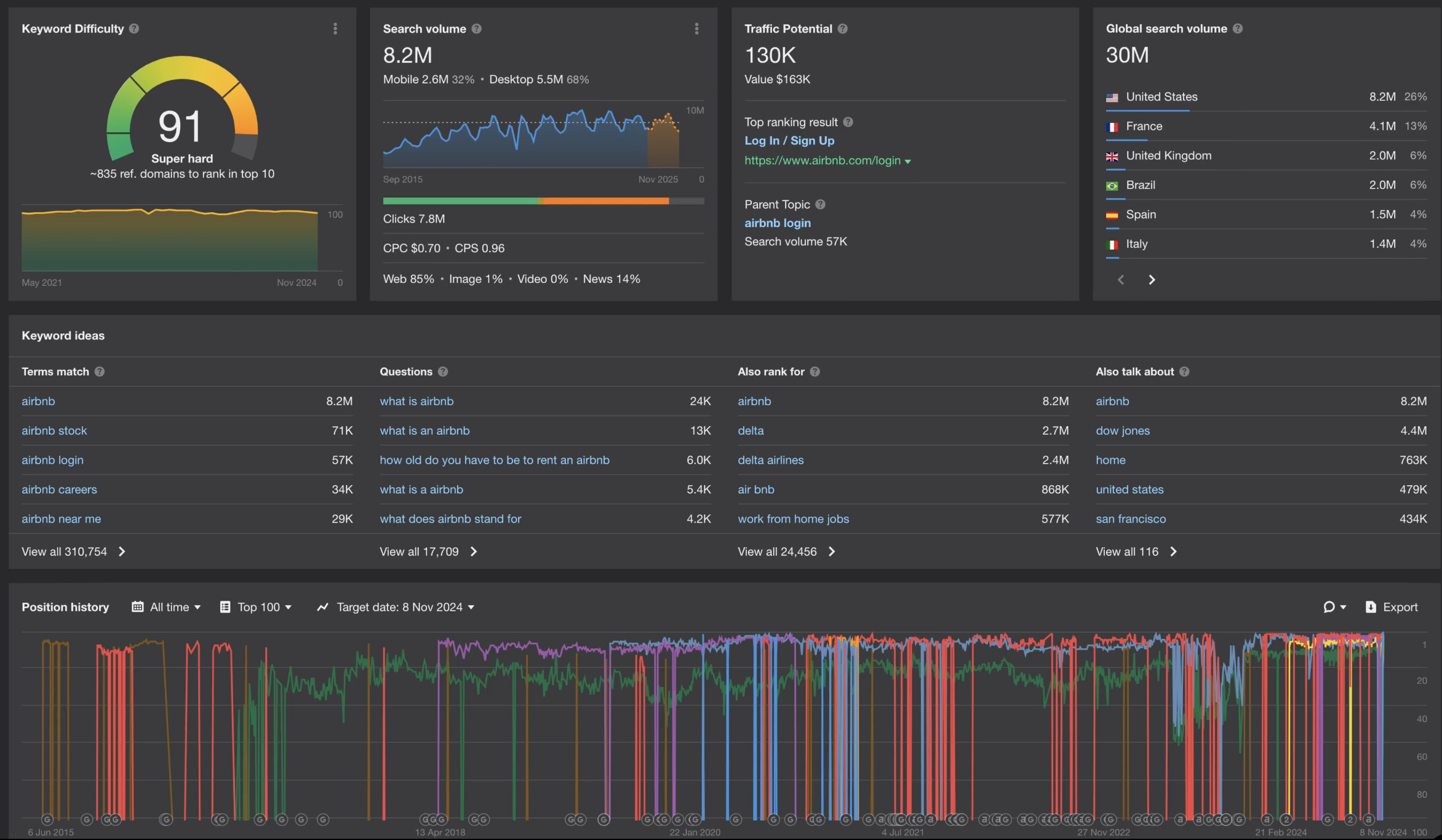
Site Audit: automated technical SEO auditing
Ahrefs Site Audit is a cloud-based crawler that scans your website for technical SEO issues, running 100+ pre-configured checks. After each crawl, issues are categorized by severity and grouped into thematic categories.
- Check coverage: Indexability, crawlability, page speed, on-page SEO, social tags, incoming and outgoing links, images, CSS, JavaScript, hreflang implementation, canonical tags, and structured data validation
- Issue categorization: Errors, warnings, and notices grouped into categories like performance, HTML tags, social tags, content quality, and localization
- Health Score: A single number (0–100) summarizing overall site health, useful as a high-level KPI for stakeholder reporting
- Scheduled crawls: Daily, weekly, or monthly depending on your plan, with crawl comparison highlighting fixed, new, and unresolved issues between sessions
- Core Web Vitals: Monitors using both field data (from Chrome User Experience Report) and lab data
- Credit-based limitations: Crawl depth and total pages scanned are limited by your plan's crawl credit allocation, shared across all projects, for sites with 50,000+ pages, this can become a significant constraint compared to dedicated crawlers like Screaming Frog or CrawlRaven that impose no per-page cost
- Missing features: No custom extraction rules, log file analysis, or JavaScript rendering configuration: features that technical SEO specialists expect from a primary auditing tool
Rank Tracker: keyword position monitoring over time
Rank Tracker monitors your keyword rankings across Google search results on a scheduled basis. You add keywords to a project, set target countries and devices, and Ahrefs checks positions at regular intervals.
- Keyword limits by plan: 750 on Lite, 2,000 on Standard, 5,000 on Advanced
- Check frequency: Default is weekly; daily tracking requires the "Project Boost Max" add-on at $20–$200/month
- Keyword reports: Current position, position changes since last check, ranking URL, search volume, traffic estimate, and SERP features for each query
- Competitor comparison: Track up to 10 competitor domains alongside your own with side-by-side ranking comparisons, visibility, average position, and traffic metrics plotted over time
- SERP feature opportunities: Flags featured snippets, People Also Ask boxes, or image packs you don't currently own
- Scheduled reports: Weekly or monthly email summaries for stakeholders, though reports cannot be white-labeled for agency client delivery
- Google-only limitation: Does not track rankings on YouTube, Bing, or Amazon, engines that Keywords Explorer supports for research
- Slower default frequency: Weekly checks are slower than competitors like SE Ranking and Semrush, which include daily tracking in base plans without add-on fees
Content Explorer: finding high-performing content by topic
Content Explorer is a search engine for web content that indexes billions of pages, letting you find articles, blog posts, and pages that have attracted backlinks, social shares, or organic traffic.
- Filtering: Filter results by referring domains, organic traffic estimate, publish date, word count, language, domain rating, and whether the page is live or removed
- Link building use case: Find broken pages with high referring domain counts and create replacement content, or identify top-performing content in your niche
- One page per domain: Toggle prevents a single site from dominating results
- Highlight unlinked domains: Cross-references results against your backlink profile to show which referring domains have never linked to you, a prioritized outreach list
- Best by links / Best by shares: Reports available within Site Explorer showing the most-linked-to and most-shared pages on any domain
- Content strategy value: Helps identify which content formats, topics, and angles consistently earn the most engagement in a given vertical
Backlink analysis: Domain Rating and URL Rating
Ahrefs maintains the largest commercial backlink index, with over 35 trillion external backlinks crawled by AhrefsBot, the second most active web crawler after Googlebot. The index is updated continuously, with new and lost backlinks reflected within hours for most domains.
- Domain Rating (DR): Measures the overall strength of a domain's backlink profile on a logarithmic 0–100 scale, factoring in the number and quality of referring domains
- URL Rating (UR): Measures the link authority of a specific URL using a similar calculation that accounts for both internal and external links
- Filtering: Filter by link type (dofollow, nofollow, UGC, sponsored, redirect), anchor text, referring domain authority, referring page traffic, first-seen and last-seen dates, language, and platform type
- Referring Domains report: Shows every unique domain linking to your target with DR, traffic estimate, number of backlinks, and dofollow ratio
- Anchors report: Aggregates anchor text distribution, useful for identifying over-optimized link profiles or unnatural link patterns
- Historical data: Chart backlink growth or decline over months or years; "New" and "Lost" views show daily link acquisition and attrition
- Link Intersect tool: Takes up to 10 competitor URLs and returns all referring domains that link to at least one of them but not to you, ranked by the number of competitors they link to, the single most efficient way to build a link-building prospect list
What is Ahrefs Rank (AR)?
Ahrefs Rank (AR) is a league table of every website in Ahrefs' index, ordered by the strength of their backlink profiles: AR #1 is the site with the highest Domain Rating, AR #2 the next strongest, and so on. It is derived directly from DR, so you never optimize for AR itself.
- It is relative, not absolute. Your AR can drop even when your own links have not changed, because other sites gained stronger referring domains and leapfrogged you.
- Use DR for tracking, AR for context. DR tells you whether your profile is getting stronger; AR only tells you where that puts you against every other site in the index.
- Where to find it: Site Explorer's overview panel shows AR next to DR and UR for any domain you check.
How often does Ahrefs DR update?
Domain Rating recalculates roughly every 12 hours, and the underlying backlink index refreshes with new and lost links every 15–30 minutes. In practice a new high-authority link shows up in Site Explorer within hours, but the DR movement it causes can take a day or two to settle.
- DR only counts dofollow referring domains. Nofollow, UGC, and sponsored links are indexed and visible in reports, but they do not move DR.
- Logarithmic scale: climbing from DR 70 to 71 takes far more link equity than DR 20 to 21, so movement slows as you go up.
- Check any domain free: our free website authority checker scores any site's link authority without an Ahrefs subscription or credits.
Does Ahrefs have a spam score?
No. Spam Score is a Moz metric; Ahrefs has no direct equivalent and its founders have argued against publishing one. If you need a toxicity signal from Ahrefs data, you have to assemble it yourself.
- The manual workaround: filter the Referring Domains report for low-DR domains, high outbound-link counts, and suspicious anchor text patterns in the Anchors report.
- For a scored metric, Moz Spam Score or Semrush's Toxicity Score are the tools that productize this; see our Moz DA vs Ahrefs DR comparison for how the two ecosystems differ.
Competitive analysis: domain comparison and gap analysis
Ahrefs' competitive analysis capabilities span multiple tools but center on Content Gap analysis and the domain comparison view in Site Explorer.
- Content Gap: Accepts your domain plus up to 10 competitor domains and returns every keyword that at least one competitor ranks for but you do not, with filters for position thresholds, search volume, keyword difficulty, and traffic potential
- Competing Domains report: Automatically identifies your closest organic competitors based on keyword overlap: shows shared keywords, unique keywords, and traffic estimates for each
- Backlink gap analysis: Shows referring domains that link to competitors but not to you, creating a targeted outreach list
- Batch Analysis: Upload up to 200 URLs or domains and pull DR, UR, organic traffic, referring domains, and keyword counts in a single export
- Organic Competitors view: Plots your domain against competitors on a scatter chart by keyword count vs. organic traffic, immediately showing whether a competitor outperforms you due to more content or higher-quality content
- Top Pages report: Shows the single most valuable page for each ranking keyword on a competitor's site, giving content teams a clear roadmap for where to focus creation efforts
What Ahrefs does well: backlinks, keywords, and competitor research
Ahrefs excels at three things: backlink analysis, keyword research, and competitive intelligence. These are not just "good" features; they are genuinely best-in-class tools that most SEO professionals consider industry standards.
Backlink analysis: the largest commercial link index
Ahrefs operates the second-largest web crawler after Google, indexing over 35 trillion external backlinks and 28 trillion internal backlinks. The Ahrefs Site Explorer provides Domain Rating (DR) and URL Rating (UR) metrics that have become industry-standard measurements for link authority. According to G2 reviews, users consistently rate the backlink database as the platform's strongest feature.
- Referring domains and backlink history: Track how your link profile grows or declines over time with historical charts going back years
- Link type filtering: Filter by dofollow, nofollow, UGC, and sponsored links with anchor text distribution analysis
- Broken backlink finder: Identify high-authority links pointing to your 404 pages for reclamation, one of the most effective link-building tactics available
- Competitor backlink gap analysis: Compare your link profile against up to 5 competitors simultaneously to find domains that link to them but not you
- New and lost backlinks: Daily updates on link changes across your domain, with email alerts for high-DR link acquisitions or losses
Keyword research: traffic potential beyond search volume
Ahrefs Keywords Explorer covers 10+ search engines and introduces the unique "Traffic Potential" metric that sets it apart from competitors.
- Traffic Potential metric: Estimates total organic traffic from all keyword variations rather than just the search volume of a single query, preventing teams from chasing low-potential keywords that look attractive on paper
- Multi-engine coverage: Supports Google, YouTube, Bing, and Amazon keyword research
- Difficulty and click data: A VP of SEO noted on G2 that Keyword Explorer's difficulty score alongside click ratio data is particularly valuable for content planning
- 2026 updates: Added global keyword research capabilities
- SERP overview: Shows the top 10 ranking pages with their DR, UR, backlinks, referring domains, traffic, and word count: giving a complete picture of what it takes to compete
Content Explorer and competitor analysis
Content Explorer and Site Explorer together form Ahrefs' content and competitive research layer.
- Content Explorer: Searches a database of billions of web pages by topic, with filters for referring domains, organic traffic, publish date, and word count
- Competitor analysis in Site Explorer: Provides comprehensive competitor analysis including organic keywords, paid keywords, traffic estimates, and content gap analysis
- "Best by links" report: Shows which pages on any domain have earned the most backlinks, revealing what content formats and topics attract links in your vertical, particularly valuable for link building
UI and learning resources
Ahrefs consistently earns praise for its clean, well-organized interface and strong educational ecosystem.
- Ease of use: Across Capterra reviews (4.5/5 ease of use rating), users highlight the logical navigation structure and the ability to quickly switch between tools without losing context
- Educational content: Ahrefs invests heavily in its YouTube channel, blog, and Academy courses, widely regarded as some of the best free SEO training available
- Lower learning curve: The combination of intuitive UI and quality training resources helps new users onboard faster and extract more value from the platform
API access and integrations
Ahrefs provides a REST API on Standard plans and above, giving teams programmatic access to platform data.
- API data coverage: Exposes backlink data, keyword data, rank tracking, and site audit results, valuable for agencies building custom dashboards, data pipelines, or automated reporting workflows
- Row-based API pricing: Each API call consumes credits from your plan, which can add up quickly for high-volume use cases but provides genuine flexibility for teams that need Ahrefs data inside their own systems
- Native integrations: Google Search Console, Google Data Studio (Looker Studio), WordPress, and several third-party SEO platforms
Where Ahrefs falls short: pricing, site audit depth, and data accuracy
Every report view, filter, and export costs credits. Starter plan (100 credits) can be burned in one session.
“The credit system would cost us an additional $500-$600/month on top of subscription.”, G2
No custom extraction, no log file analysis, no white-label reports. Crawl credits shared across all projects.
“Site Audit is too basic compared to dedicated crawlers. It misses a lot of issues.”, G2
Traffic estimates can diverge significantly from Google Search Console. Worst for long-tail and new domains.
“GSC showed strong traffic growth while Ahrefs reported keyword losses.”, Reddit r/SEO
No NLP content editor, no content scoring. Research stops before writing. Need Surfer/Clearscope on top.
Ahrefs has three significant weaknesses, a confusing credit-based pricing model that frustrates users at every tier, a site audit module that cannot match dedicated crawling tools, and data accuracy gaps compared to Google Search Console.
That third one is less a defect than a category difference: Ahrefs traffic is a model and Search Console is a record, which is why a study of 7,500+ sites still found them the closest-correlating pair of the three common sources.
The credit system: every click costs you
Ahrefs switched to credit-based pricing in 2024, and user backlash has been severe. On Trustpilot, Ahrefs holds a 1.9/5 rating from 300+ reviews, a stark contrast to its 4.5/5 on G2.
The fundamental problem: every report view, every filter change and every export consumes credits from a shared monthly pool, which turns exploratory research into a metered activity.
- Rapid credit depletion: Trustpilot reviewers report that the $29 Starter plan's credit pool (200/month as of July 2026) can be consumed in a single session of basic research; see our worked burn-rate example below
- Hidden costs for agencies: A G2 reviewer estimated the credit system would cost an additional $500–$600/month on top of their subscription, totaling around $8,000/year
- Account restrictions on paid plans: Multiple users on Trustpilot report being flagged for "suspicious activity" during normal usage
- Feature gating: Search intent data, keyword clustering, and AI suggestions require the $249/month Standard plan or higher
- Add-on costs for daily tracking: Daily rank tracking requires a "Project Boost Max" add-on at $20–$200/month on top of your base subscription
Site audit: a bolt-on module, not a dedicated platform
Ahrefs Site Audit is a competent basic crawler, but it is a module within an all-in-one platform, not a purpose-built auditing tool. According to a Style Factory Productions review, key limitations include:
- Credit-based crawling: Crawl credits are shared across all projects. A single large-site audit can consume an entire month's budget
- No custom extraction: Unlike Screaming Frog (regex, XPath, CSS selectors), Ahrefs provides no custom data extraction
- No log file analysis: Cannot analyze server logs to understand actual Googlebot behavior
- Cloud-only: Cannot crawl from your own IP or behind authentication without workarounds
- No white-label reports: Cannot brand audit reports for client delivery
- No auto-prioritized fix lists: Unlike CrawlRaven, which generates prioritized fix recommendations ranked by SEO impact, Ahrefs presents issues as flat lists grouped by category without priority scoring
Data accuracy concerns
Multiple Reddit users report discrepancies between Ahrefs data and Google Search Console data.
- Traffic estimation gaps: One r/SEO thread describes Google Search Console showing strong traffic growth while Ahrefs reported keyword losses and only reflected a fraction of actual traffic
- Third-party data limitation: All third-party SEO tools rely on clickstream data and sampling rather than direct access to Google's index, but users report the gap is wider with Ahrefs than with some competitors
- Weakest for long-tail and new domains: Discrepancies are particularly pronounced for long-tail keywords and newer domains where Ahrefs' sampling coverage is thinner
Limited content optimization capabilities
Unlike Surfer SEO or Clearscope, Ahrefs does not offer a dedicated content optimization editor with NLP-based scoring.
- No content scoring: There is no tool within Ahrefs that analyzes your draft content against top-ranking pages and scores it for topical coverage, word count, heading structure, or term frequency
- Research without optimization: Content Explorer helps you find successful content and Keywords Explorer identifies what to target, but the workflow stops before the writing stage
- Additional tooling required: Teams that need both keyword research and content scoring will need to pair Ahrefs with a separate content tool, which adds cost and workflow complexity
Does Ahrefs have a WordPress plugin?
Not anymore. The Ahrefs SEO WordPress plugin was retired on October 31, 2025, and Ahrefs says its content-audit functionality is being folded into the Ahrefs Toolkit browser extension instead.
- What it did: automated content audits inside wp-admin, combining GA traffic with Ahrefs backlink data to flag posts to update, rewrite, or delete.
- The replacement workflow: verify your site in Ahrefs Webmaster Tools (free for site owners) and run the same audit from the web app rather than inside WordPress.
- If you want SEO checks in the CMS itself, that job now belongs to Yoast, Rank Math, or a crawler that audits the rendered site, since Ahrefs no longer plays there.
Ahrefs pricing in 2026: every plan compared
Ahrefs pricing starts at $29/month for the severely limited Starter plan (200 credits), with the Lite plan at $129/month being the practical minimum for most users. Prices below were verified against ahrefs.com/pricing in July 2026; note that the Enterprise plan jumped from $999 to $1,499/month and now requires an annual commitment.
| Plan | Monthly | Annual (per mo) | Projects | Tracked KWs | Crawl Credits/mo |
|---|---|---|---|---|---|
| Starter | $29 | $29 | 1 | 50 | 10,000 |
| Lite | $129 | $107.50 | 5 | 750 | 100,000 |
| Standard | $249 | $207.50 | 20 | 2,000 | 500,000 |
| Advanced | $449 | $374.17 | 50 | 5,000 | 1,500,000 |
| Enterprise | $1,499 (annual only) | $1,499 | Custom | Custom | Custom |
Key pricing details:
- All plans include only one user seat.
- The Lite plan lacks search intent data and keyword clustering.
- Daily rank tracking needs a "Project Boost Max" add-on at $20–$200/month extra.
- Unlike Semrush, Ahrefs offers no free trial.
- The Starter crawl-credit figure is for unverified projects (max 500 pages). Verified projects get 5,000 crawl credits each per month.
How much annual billing actually saves
Annual billing gives you two months free, a 16.7% discount that Ahrefs rounds up to "up to 17%" in its marketing. The math, per plan:
- Lite: $129 × 12 = $1,548/year monthly vs. $1,290/year annual: you save $258/year (16.7%), effective $107.50/month
- Standard: $249 × 12 = $2,988/year vs. $2,490/year: saves $498/year, effective $207.50/month
- Advanced: $449 × 12 = $5,388/year vs. $4,490/year: saves $898/year, effective $374.17/month
- Enterprise: $1,499/month billed annually ($14,990/year after the two-free-months discount is applied to the $17,988 list total); there is no monthly option at this tier
Add-ons stack on top of these figures:
- Extra seats. $40/month each on Lite (max 2), $60/month on Standard (max 5), $80/month on Advanced (max 10).
- Report Builder. Another $99/month.
- Content Kit. From $99/month.
- Brand Radar, Ahrefs' AI-visibility module. From $199/month.
A two-person agency on Standard with Report Builder is realistically paying $408/month, not $249.
Why does your Ahrefs charge say FastSpring?
FastSpring is Ahrefs' merchant of record: it processes every Ahrefs payment, so the charge on your card statement shows FastSpring (often “FS” plus a reference) rather than Ahrefs. It is not a billing error and not fraud, provided you actually hold an Ahrefs subscription.
- Invoices and VAT: receipts come from FastSpring, and the link in your order confirmation opens FastSpring's subscription manager, where you can download invoices, add a VAT ID, or update the card.
- Cancellations and refunds also route through that same FastSpring subscription manager or Ahrefs' own billing settings; disputing the charge with your bank instead will simply get the account suspended.
- As merchant of record, FastSpring handles local sales tax and VAT collection, which is why buyers outside the US see tax added at checkout in their own currency.
Bottom line on Ahrefs pricing
Reading the tiers honestly:
- Starter, $29/month. Almost useless. 200 credits disappear in a week of light research.
- Lite, $129/month. The real starting point, but still no search intent data and no keyword clustering.
- Standard, $249/month. Where Ahrefs becomes fully functional, and a significant spend for a tool that includes neither content optimization nor deep technical auditing.
If you only need backlink analysis and keyword research, Lite is sufficient. If you run an agency or manage multiple projects, Standard pays for itself with 20 projects and 2,000 tracked keywords. Skip Enterprise unless you have 50+ projects.
The biggest hidden cost is the credit system. Budget an extra $50–$200/month for credits on top of your plan if you do regular competitor research.
How Ahrefs credits work (and how fast you burn them)
Ahrefs credits are the single most misunderstood part of the platform, so here is the system in plain terms, per Ahrefs' own help docs (verified July 2026):
- What costs a credit: 1 credit is consumed every time you open a report, apply a filter, or request additional data in Site Explorer, Keywords Explorer, Content Explorer, and most other tools. Yes: changing a filter on a report you already have open costs another credit.
- What does NOT cost credits: Site Audit and Rank Tracker run on their own separate limits (crawl credits and tracked keywords), so auditing and rank checking never touch your research credit pool.
- Monthly allowances: Starter gets 200 credits/month. Lite includes one "Power" user with 1,000 credits/month. Standard and Advanced now give active users unlimited credits; this is the quiet reason the $249 Standard plan is where credit anxiety actually stops.
- Extra users are metered: a teammate who spends 0–5 credits is free, 6–100 credits costs $20/month ("Casual"), and beyond that they become a "Power" user at $40/month on Lite, $60 on Standard, $80 on Advanced.
- Running out: with pay-as-you-go enabled, overage bills automatically at $50 per 500 extra credits; purchased credits expire after 3 billing months. Credits never roll over; unused allowance resets on your renewal date.
A worked example: one competitor analysis session
Say you research one competitor on the Lite plan. You open Site Explorer's overview (1 credit), the Organic Keywords report (1), filter to positions 1–10 (1), filter again to volume > 500 (1), open Top Pages (1), Backlinks (1), filter to dofollow (1), Referring Domains (1), Content Gap against your domain (1), and adjust the gap filters twice (2).
That is 11 credits for one competitor, and a realistic session digs deeper than that.
Run that workflow for a 5-competitor landscape analysis and you have spent 55+ credits in an afternoon.
- Four research days a week burns roughly 880–1,000 credits a month, which is exactly the Lite allowance.
- On Starter's 200 credits, a single thorough competitive analysis can consume most of your month.
This is why Trustpilot reviews complain about exploratory research feeling metered: on Starter and Lite, it literally is. If your team does daily research, price Standard ($249/month, unlimited credits for active users) against Lite plus $50–$100/month in overage. Standard often wins.
How Ahrefs crawl credits work (Site Audit limits)
Crawl credits are a separate pool from research credits: one crawl credit is one URL crawled by Site Audit, and opening reports never touches them. Each plan carries a monthly allowance, roughly 100,000 crawl credits on Lite, 500,000 on Standard, and 1.5 million and up on Advanced and Enterprise, with per-project caps inside those totals.
- Two different crawlers: AhrefsBot builds the backlink index by crawling the whole web on its own schedule; Site Audit's crawler only visits your verified projects when you run an audit, and only the latter consumes crawl credits.
- Recrawls count in full. A weekly scheduled audit of a 20,000-URL site burns 80,000+ crawl credits a month on its own, which is most of a Lite allowance.
- Where to check usage: the crawl log and credit meter sit in Site Audit's project settings, and the always-on audit option crawls continuously at 10–30 pages per minute depending on plan.
- If audit crawling is your main workload, a dedicated crawler is cheaper per URL: see our Screaming Frog review ($279/year, unlimited crawls) or Sitebulb review.
Ahrefs pros and cons
The full picture from our testing and 1,500+ aggregated third-party reviews, condensed:
- ✓Largest commercial backlink index: 35T+ external links, updated within hours
- ✓Traffic Potential metric prioritizes keywords better than raw search volume
- ✓Keywords Explorer covers 10+ engines (Google, YouTube, Amazon, Bing, Baidu...)
- ✓Content Explorer and Link Intersect are the fastest link-prospecting workflow available
- ✓Clean UI plus best-in-class free training (Ahrefs Academy, YouTube)
- ✓Unlimited credits for active users on Standard ($249/mo) and above
- ✗Credit system meters every report view and filter change on Starter/Lite plans
- ✗No free trial, unlike Semrush (7-day) and SE Ranking (14-day)
- ✗Site Audit is a bolt-on: no custom extraction, log file analysis, or white-label reports
- ✗Every plan includes just 1 seat; extra users cost $40–$80/month each
- ✗Daily rank tracking costs extra ($20–$200/mo add-on); default is weekly
- ✗Enterprise now $1,499/month with mandatory annual commitment (up from $999)
- ✗1.9/5 on Trustpilot, mostly credit-system and billing complaints
Who should buy Ahrefs in 2026, and who should not
Ahrefs is worth it if you
- Need best-in-class backlink data: no other tool matches Ahrefs' link index depth
- Do regular competitor research: Site Explorer and Content Explorer are unmatched for competitive intelligence
- Already have a content optimization tool (Surfer, Clearscope) and need the research layer underneath
- Run an agency managing 5+ client projects: Standard plan gives you 20 projects with solid keyword tracking
Ahrefs is NOT worth it if you
- Are on a tight budget: Lite at $129/month is the minimum useful plan, and it meters your research. SE Ranking Core costs the same $129/month ($103.20 annual) but includes white-label reporting and daily rank tracking that Ahrefs charges extra for
- Need content optimization: Ahrefs has no content editor or NLP scoring. You will need Surfer ($79/month) or Frase ($49/month) on top
- Need deep technical site auditing: Ahrefs Site Audit runs ~100 checks. Dedicated crawlers like CrawlRaven ($49 at launch) or Screaming Frog ($279/year) run 200-300+ checks with custom extraction and prioritized fixes
- Hate metered pricing: the credit system means every click costs you. If you do a lot of exploratory research, credits run out fast
If any of those describe you, see the best Ahrefs alternatives by use case. We break down which tool wins for budget keyword research, content optimization, and deep technical auditing.
Which Ahrefs plan should you choose?
- Starter ($29/month): Only useful for occasional lookups. 200 credits is nothing for real research. Skip this unless you check one domain per week.
- Lite ($129/month): The real entry point. 5 projects, 750 tracked keywords, 100K crawl credits. Good for freelancers and small teams doing keyword research and link analysis.
- Standard ($249/month): Best value for agencies. 20 projects, 2,000 keywords, search intent data, keyword clustering, and Content Explorer. This is where Ahrefs becomes fully functional.
- Advanced ($449/month): Only if you manage 50+ projects or need 5,000 tracked keywords. The jump from Standard is steep for what you get.
- Enterprise ($1,499/month, billed annually): Large agencies and in-house teams that need uncapped API access, SSO, and audit logs. Requires an annual commitment ($14,990/year).
Is Ahrefs worth the money?
Yes: if backlink intelligence or competitor research drives your revenue, Ahrefs is worth $129–$249/month; for everyone else, cheaper tools cover 80–90% of the same ground. That is the whole verdict in one sentence. Here is how it breaks down by situation:
- Freelancer / solo consultant: Borderline. Lite at $129/month ($107.50 annual) is a real cost against a small retainer base, and the 1,000-credit cap punishes exploratory research. If clients pay you specifically for link building or content strategy, it earns its keep; if you mostly deliver audits and rankings reports, SE Ranking or CrawlRaven plus free tools is the smarter spend.
- Agency: Worth it at Standard ($249/month). Twenty projects, 2,000 tracked keywords, and unlimited credits for active users make the per-client cost trivial, but budget for extra seats ($60/month each) and remember there is still no white-label reporting, so you will pair it with a reporting layer anyway.
- In-house team: Worth it if organic is a primary channel. Standard or Advanced replaces two or three point tools for research, and the API (Standard+) feeds internal dashboards. If your site is large and technical SEO is the bottleneck, the bundled Site Audit will not be enough on its own.
| Tool | Entry Price | Wins When |
|---|---|---|
| Ahrefs | $129/mo (Lite) | Backlink data and competitor research are the job |
| Semrush | $139.95/mo (Pro) | You want one suite for SEO + PPC + content + social |
| CrawlRaven | $49 at launch | Technical audits, white-label reports, AI-visibility tracking |
Still on the fence? We compared every serious option (by price, use case, and what Redditors actually recommend) in our guide to the best Ahrefs alternatives in 2026.
Why you should trust this Ahrefs review: our testing methodology
This review is based on hands-on testing of Ahrefs Site Explorer, Keywords Explorer, Site Audit, Content Explorer, and Rank Tracker across multiple domains and keyword sets. We compared Ahrefs directly against Semrush, SE Ranking, and Moz using the same target keywords and test websites.
Our evaluation criteria: backlink index depth, keyword data accuracy (cross-referenced against Google Search Console), site audit coverage, ease of use, pricing value, and API flexibility.
We also cross-referenced our findings with third-party review data from G2 (4.5/5, 600+ reviews), Capterra (4.7/5, 570+ reviews), and Trustpilot (1.9/5, 300+ reviews). The Trustpilot score is notably low, most negative reviews cite the credit-based pricing system introduced in 2024.
Disclosure: CrawlRaven is our product, but this review focuses on Ahrefs' strengths and weaknesses as a backlink analysis and keyword research platform. Where Ahrefs excels, particularly in backlink data depth, we say so clearly. This is an honest review, not a competitor takedown.
Sources for this Ahrefs review
- Ahrefs Official Pricing, verified July 2026
- Ahrefs Help: Usage-Based Pricing for Credit-Based Plans, credit mechanics, verified July 2026
- Ahrefs on G2: 4.5/5 from 600+ reviews
- Ahrefs on Capterra: 4.7/5 from 570+ reviews
- Ahrefs on Trustpilot: 1.9/5 from 300+ reviews (credit system complaints)
Frequently asked questions
Is Ahrefs worth the price in 2026?
Ahrefs is worth the price if backlink analysis and competitor research are your primary needs and you can afford the $249/month Standard plan for full feature access. For users who primarily need site auditing, CrawlRaven ($49 at launch) or Screaming Frog ($279/year) provide deeper audits at significantly lower cost.
What is the cheapest Ahrefs plan?
The cheapest Ahrefs plan is the Starter at $29/month. However, it includes only 200 credits, 50 tracked keywords, and 1 unverified project, making it severely limited for real SEO work. The Lite plan at $129/month (or $107.50/month billed annually) is the practical minimum for most users.
How much does Ahrefs cost per year?
On annual billing (two months free, ~17% off), Ahrefs Lite costs $1,290/year ($107.50/month), Standard costs $2,490/year ($207.50/month), Advanced costs $4,490/year ($374.17/month), and Enterprise costs $14,990/year ($1,499/month with a mandatory annual commitment). Paying monthly instead adds $258/year on Lite, $498/year on Standard, and $898/year on Advanced. Prices verified July 2026.
How do Ahrefs credits work?
One credit is consumed each time you open a report, apply a filter, or request new data in Site Explorer, Keywords Explorer, and most other tools; Site Audit and Rank Tracker have separate limits and never use credits. Starter includes 200 credits/month, Lite includes 1,000 per user, and Standard/Advanced give active users unlimited credits. Credits reset monthly with no rollover; overage costs $50 per 500 extra credits with pay-as-you-go enabled.
How fast do Ahrefs credits run out?
Faster than most users expect: a single competitor deep-dive (overview, keyword reports, filters, backlink reports, content gap) consumes roughly 10-15 credits, so a 5-competitor analysis burns 55+ credits in one session. At that pace the Starter plan's 200 credits last about a week and Lite's 1,000 credits about a month. Teams doing daily research should price the Standard plan, which removes credit limits for active users.
Did Ahrefs Enterprise pricing increase in 2026?
Yes. As of July 2026, Ahrefs Enterprise costs $1,499/month billed annually ($14,990/year) with a mandatory annual commitment, up from the $999/month previously listed. It adds uncapped API access, SSO, audit logs, and unlimited historical data on top of the Advanced plan.
Does Ahrefs offer a free trial?
No, Ahrefs does not offer a free trial as of 2026. This is a significant disadvantage compared to Semrush, which offers a 14-day free trial. Ahrefs does offer limited free tools including a backlink checker and keyword generator, but these provide only a fraction of the paid platform's data.
Is Ahrefs better than Semrush?
Ahrefs is better than Semrush for backlink analysis specifically. It has a larger link index (35+ trillion links). Semrush is better for all-in-one SEO workflows, offering a stronger site audit module, PPC tools, content marketing features, and social media management that Ahrefs lacks.
Why is Ahrefs so expensive?
Ahrefs' costs add up because the credit-based system charges for nearly every action beyond the base subscription. Additional costs include extra user seats, daily rank tracking add-ons ($20–$200/month), and higher-tier plans needed for features like search intent data and keyword clustering.
What are the best Ahrefs alternatives for site auditing?
The best Ahrefs alternatives for site auditing are CrawlRaven ($49 at launch, 200+ auto-prioritized checks; white-label reports on the $99 launch tier), Screaming Frog ($279/year, deepest desktop crawl customization), and Sitebulb ($162/year, visual audit insights). All three provide deeper technical auditing than Ahrefs' built-in module at lower cost.
How accurate is Ahrefs data compared to Google Search Console?
Ahrefs data can differ significantly from Google Search Console. Multiple users report Ahrefs showing lower traffic and keyword counts than GSC's first-party data. While no third-party tool perfectly mirrors Google's data, users should treat Ahrefs metrics as estimates and verify critical decisions against GSC.
Can Ahrefs replace Screaming Frog for site auditing?
No. Ahrefs Site Audit cannot replace Screaming Frog for serious technical SEO work. Screaming Frog offers custom extraction (regex, XPath, CSS selectors), log file analysis, full JavaScript rendering control, and unlimited crawl customization, none of which Ahrefs provides. Ahrefs' audit is better suited as a quick overview, not a deep technical analysis.
Why does my Ahrefs charge say FastSpring?
FastSpring is Ahrefs' merchant of record and processes all Ahrefs payments, so card statements show FastSpring rather than Ahrefs. Invoices, VAT details, card changes, and cancellations are all handled through the FastSpring subscription manager linked in your order confirmation email. It is not fraud if you hold an active Ahrefs subscription.
What is Ahrefs Rank (AR)?
Ahrefs Rank orders every website in Ahrefs' index by backlink profile strength: AR #1 is the site with the highest Domain Rating, AR #2 the next, and so on. It is derived directly from DR and is relative, so your AR can fall even when your own backlinks have not changed, simply because other sites gained stronger links.
How often does Ahrefs update Domain Rating?
Domain Rating recalculates roughly every 12 hours, and the backlink index behind it refreshes every 15-30 minutes. New links usually appear in Site Explorer within hours, while the DR impact settles over a day or two. DR only counts dofollow referring domains; nofollow and sponsored links are indexed but do not move the score.
What are Ahrefs crawl credits?
Crawl credits meter Ahrefs' Site Audit tool: one credit equals one URL crawled, on a separate monthly pool from research credits (roughly 100,000 on Lite, 500,000 on Standard, 1.5 million+ on Advanced). Scheduled recrawls count in full, so a weekly audit of a 20,000-URL site consumes 80,000+ crawl credits per month.
Does Ahrefs have a WordPress plugin?
No. The Ahrefs SEO WordPress plugin was retired on October 31, 2025. Ahrefs recommends running content audits through Ahrefs Webmaster Tools (free for verified site owners) instead, with plugin functionality being folded into the Ahrefs Toolkit browser extension.
How does Ahrefs compare to other SEO tools?
Its backlink index is the strongest reason to choose it, and its keyword data is competitive. Where it is weaker is site auditing, which does not match dedicated crawlers, and its credit-based pricing, which frustrates users at every tier. For your own site's performance data, Search Console remains more accurate than any third-party estimate.
What are SEO keywords, in Ahrefs' definition?
The queries a page ranks for in Ahrefs' index, each carrying an estimated search volume and difficulty score. Both figures are modelled rather than measured, which is worth remembering when they disagree with your own data: one is an estimate of demand, the other is a record of what actually happened.

15+ years of growing SaaS websites through SEO | Author, 200-Point Audit Checklist
Aditi has spent 15+ years helping SaaS companies scale organic traffic through technical SEO and content strategy. She is the author of the CrawlRaven 200-Point Audit checklist used by agencies and in-house teams to systematically improve search performance.