Semrush Review 2026: Pricing, Features & Honest Verdict
An honest Semrush review covering pricing ($139–$499/mo), site audit limitations, real user complaints, and better alternatives for technical SEO auditing in 2026.

Semrush is the most comprehensive all-in-one SEO platform, with industry-leading keyword research and competitive intelligence.
- The catch: $139–$499/month, with aggressive feature gating and a site audit module that lacks crawl depth.
- Best for: marketing teams who need keyword research, PPC data, and competitive analysis in one dashboard.
- Skip if: you need deep technical crawling, white-label audit reports, or are on a tight budget.
Agencies and technical SEO teams needing deep auditing should consider dedicated tools like CrawlRaven ($49 at launch for 200+ checks), or pair Ahrefs with Screaming Frog.
Semrush is a powerful all-in-one platform, and it will happily show you 2,000 keywords and 2,000 issues. Deciding which ten matter this week is still your job. CrawlRaven joins your Semrush export to live Search Console data and a 200-point crawl, then hands back that ranked shortlist. Try CrawlRaven free: 1 site, no credit card →
Semrush is the most comprehensive all-in-one SEO platform in 2026. Plans start at $139/month. Strengths: industry-leading keyword database, competitive intelligence, PPC data, and content marketing tools all in one dashboard. Weaknesses: aggressive feature gating, site audit module lacks crawl depth compared to dedicated crawlers, expensive at $139-$499/month.
Semrush Review Verdict: 3.8 / 5
Semrush is the most feature-rich all-in-one SEO platform in 2026. Its keyword database (26B+ keywords) and competitive intelligence tools are best-in-class. But the site audit module lacks depth compared to dedicated crawlers, and pricing is aggressive: $139-$499/month with key features gated behind expensive tiers.
Marketing teams needing keyword research, PPC analysis, and competitive intelligence in one dashboard
You need deep technical site auditing, white-label audit reports, or are on a budget under $100/month
Semrush capability scorecard
“The keyword database is unmatched. Position tracking is incredibly accurate.”
★★★★★G2
“Best all-in-one SEO platform. Everything you need in one dashboard.”
★★★★★Capterra
“Pricing is aggressive. They gate basic features behind expensive tiers.”
★★★★★G2
“The site audit module is shallow compared to dedicated crawlers like Screaming Frog.”
★★★★★Trustpilot
“Constant upselling. Every feature seems to need an add-on or upgrade.”
★★★★★Trustpilot
| Category | Rating | Key Detail |
|---|---|---|
| Keyword Research | ★★★★★ | 26B+ keywords, 142 countries, intent classification on every keyword. |
| Competitive Intelligence | ★★★★★ | Domain comparison, keyword gap, traffic analytics, market explorer. |
| Site Audit | ★★★☆☆ | ~140 checks. Lacks orphan page detection, redirect chain mapping, custom extraction. |
| Rank Tracking | ★★★★☆ | Daily updates. Share of Voice + cannibalization detection. 500-5,000 keywords by plan. |
| Content Marketing | ★★★★☆ | SEO Writing Assistant, topic research, AI drafts. Guru plan ($250/mo) required. |
| Pricing Value | ★★☆☆☆ | $139-$499/mo. Aggressive feature gating. Extra seats $45-$100/mo each. |
What is Semrush? A quick overview
Semrush is an all-in-one SEO platform used by over 10 million marketers. It covers keyword research, competitive analysis, site auditing, rank tracking, content tools, PPC research, and social media.
Founded in 2008. Publicly traded since 2021. Adobe acquired Semrush in late 2025 for $1.9 billion.
Semrush has the largest keyword database of any SEO tool. 26+ billion keywords across 142 countries. That makes it the go-to for keyword research and competitive intelligence.
But is it the right tool for you? This review covers where Semrush excels, where it falls short, and whether it is worth the price.
Semrush key features: what the platform actually does
Semrush calls itself an all-in-one marketing toolkit. Here is what that means in practice. Seven core features, broken down by what each one does and where it falls short.
Keyword Magic Tool
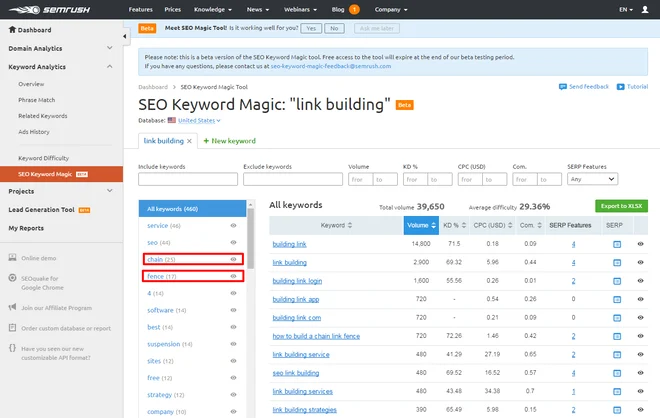
The Keyword Magic Tool is the main reason people buy Semrush. Enter a seed keyword and it returns clusters grouped by topic. Each keyword shows search volume, difficulty score, CPC, competitive density, and SERP features.
The database has 26+ billion keywords across 142 countries. No other tool has a bigger keyword index.
What makes it different: intent classification. Every keyword is tagged as informational, navigational, commercial, or transactional. You can filter by intent to separate top-of-funnel queries from bottom-of-funnel buying terms.
Other filters include question-based keywords, broad match, phrase match, and term exclusions. Pro plan gives 10,000 results per report. Guru raises that to 30,000. Business goes to 50,000.
For international SEO, Semrush's non-English keyword data is noticeably richer than Ahrefs or Moz.
Site Audit
Semrush Site Audit is a cloud-based crawler. It scans your site for technical SEO issues and gives you a health score. The crawler runs 140+ checks covering crawlability, HTTPS, internal linking, performance, Core Web Vitals, hreflang, and structured data.
Pro plan: 100,000 pages per month across all projects. Five client sites at 20K pages each and you are at your limit. Guru: 300,000 pages. Business: 1,000,000 pages.
You can schedule weekly audits on Guru and Business plans. The crawler supports JavaScript rendering, which is important for SPAs and client-side rendered sites.
Issues are grouped by severity: errors, warnings, notices. Each issue has an explanation and a fix suggestion. But the prioritization is basic. It does not rank issues by SEO impact or give you an ordered fix list.
Missing features: no orphan page detection, no redirect chain mapping, no structured data completeness checks, no log file analysis.
Backlink Analytics
Semrush has the second-largest backlink index: 43 trillion backlinks from 1.6 billion referring domains. Only Ahrefs is bigger.
Backlink Analytics shows Authority Score, referring domains, backlink types, follow vs nofollow, and anchor text. You can drill into individual domains and track new and lost backlinks over time.
The Backlink Audit tool flags toxic links using machine learning. You can export a disavow file directly to Google. The Backlink Gap tool compares up to five domains to find sites that link to competitors but not you.
For pure link building, Ahrefs' index is fresher and slightly larger. But Semrush's backlink data is strong enough for most use cases. The advantage is having it in the same platform as your keyword and competitive data.
Position Tracking
Position Tracking monitors daily keyword rankings across Google, Bing, and Baidu. Pro: 500 keywords. Guru: 1,500. Business: 5,000.
Rankings tracked at country, state, city, and ZIP code level. Separate desktop and mobile tracking. The tool shows SERP features for each keyword: featured snippets, People Also Ask, local packs, AI Overviews, and more.
Two features stand out. First, cannibalization detection. It finds keywords where your own pages compete against each other. This helps you consolidate content and stop diluting your rankings.
Second, Share of Voice. It shows your traffic share across all tracked keywords vs competitors. One number that tells stakeholders how visible you are. Much better than raw position data for reporting.
Content Marketing Toolkit
The Content Marketing Toolkit needs the Guru plan ($250/month). It is not on Pro.
Three main tools. Topic Research finds content ideas in your niche. SEO Content Template generates a brief from top-10 page analysis: word count, related keywords, readability, and backlink targets.
The SEO Writing Assistant works inside Google Docs, WordPress, and Semrush. It scores your content on four things: SEO, readability, originality, and tone of voice. It also has AI rephrasing and draft generation.
For content teams publishing lots of articles, this workflow is hard to beat. But it is tuned for blog posts. Less useful for product pages or landing pages.
Competitive Analysis
Semrush has the deepest competitive analysis of any SEO platform. Traffic Analytics shows estimated visits, traffic sources, top pages, and subdomain data for any domain.
Domain vs Domain compares up to five sites across organic keywords, paid keywords, and backlinks. Organic Research shows every keyword a competitor ranks for.
The Keyword Gap tool is one of Semrush's most useful features. Enter your domain plus four competitors. It shows shared keywords, unique keywords, keywords where you rank lower, and untapped keywords where competitors rank but you do not.
Market Explorer goes wider: market sizing, growth trends, key players, and audience demographics. Having domain, keyword, and market analysis in one platform saves hours of tool-switching.
AI Visibility Toolkit
The AI Visibility Toolkit launched in late 2025 as part of Semrush One. It tracks how your brand appears in AI search results: Google AI Overviews, ChatGPT, Perplexity, and other AI platforms.
It shows how often your brand is cited, which queries trigger mentions, and how you compare to competitors in AI results. The AI Overview monitor tracks which of your pages appear in Google's AI summaries.
This is still evolving. Adobe's AI infrastructure should accelerate development. For now, it is the most developed AI visibility solution inside a major SEO platform.
What Semrush does well
Keyword research and competitive intelligence
The Keyword Magic Tool is Semrush's best feature. 26+ billion keywords with intent classification. It finds long-tail opportunities and content gaps that other tools miss.
The Keyword Gap tool compares up to five domains. It shows exactly which keywords your competitors rank for that you do not. Filter by search intent to focus on high-commercial terms.
According to a G2 reviewer, one user described how checking a single keyword led them to map out an entire content strategy, with data showing traffic drops and competitor surges across their niche. The depth of the keyword database is particularly noticeable for non-English languages and long-tail queries where competing tools like Moz return sparse data.
All-in-one platform breadth
No other SEO tool covers this much. Keyword research, backlinks, rank tracking, site auditing, content marketing, PPC, social media, and local SEO. All under one login.
The real advantage: data flows between modules. Keyword research feeds into rank tracking. Rank tracking feeds into content recommendations. You lose that when you stitch together separate tools.
A Capterra reviewer noted that Semrush provides actionable insights to optimize content, with rich data on keyword rankings and competitor analysis that goes beyond raw numbers. The single-dashboard approach is especially valuable for teams where different members handle SEO, paid search, and content: everyone works from the same data source rather than reconciling exports from three different platforms.
PPC and advertising research
Semrush's overlap between organic SEO and paid search data is unique. You can see which keywords competitors bid on, estimate their ad spend, and review their ad copy history going back years. The Advertising Research tool shows competitor ad positions, display ad creatives, and product listing ad data. This crossover between SEO and PPC makes it particularly valuable for teams managing both channels, as you can identify keywords where organic rankings are strong enough to reduce paid spend, or where paid campaigns should fill gaps while organic rankings build.
Position tracking with granularity
Daily rank tracking with location-level, device-level, and SERP feature tracking. Semrush tracks featured snippets, People Also Ask, AI Overviews, and local pack positions, giving you visibility into how your rankings appear in real search results, not just raw position numbers. The cannibalization detection and Share of Voice metrics add analytical depth that basic rank trackers lack, making it easier to translate position data into strategic decisions and stakeholder-ready reports.
Where Semrush falls short
No orphan page detection, no redirect chain mapping, no structured data completeness checks. Crawl pages shared across all projects.
“The site audit module is shallow compared to dedicated crawlers like Screaming Frog.”, Trustpilot
Pro $140/mo lacks content tools, historical data, and API. Guru $250/mo needed for content marketing. Extra seats $45-$100/mo each.
“Pricing is aggressive. They gate basic features behind expensive tiers.”, G2
Trustpilot 2.8/5 driven by billing complaints. Users report charges during cancelled trials, aggressive auto-renewals, strict refund policies.
“Constant upselling. Every feature seems to need an add-on or upgrade.”, Trustpilot
Traffic estimates can diverge 30-50% from actual analytics for smaller sites. Long-tail and branded queries underreported.
Site audit depth is limited
Semrush Site Audit checks common issues: broken links, crawl errors, HTTPS, and Core Web Vitals. But it is a module, not a dedicated crawler.
Pro plan: 100,000 pages/month shared across all projects. Five client sites at 20K pages each and you hit the limit. Guru: 300K pages. Business: 1M pages. At $250–$500/month, you pay more than dedicated audit tools.
The real problem is depth, not volume. Semrush runs about 140 checks. That covers the basics. But it misses orphan pages, redirect chain mapping, schema completeness checks, and log file analysis.
It also has no auto-prioritized fix list. Issues are grouped by severity (errors, warnings, notices) but not ranked by SEO impact. You still need to manually triage everything.
Pricing is steep and aggressively gated
At $139.95/month, Semrush is one of the most expensive SEO tools. But the real pain is feature gating. Content marketing tools, historical data, and the Content Marketing Toolkit need the Guru plan at $250/month. API access needs Business at $500/month.
The features most teams actually need require doubling the base price. For freelancers, Pro feels like a demo.
Extra seats make it worse. Adding a user costs $45–$100/month per tier. For agencies with 3+ SEO specialists, that adds up fast. Compare: SE Ranking includes multiple seats at lower tiers. Screaming Frog covers unlimited users on one machine. A G2 reviewer highlighted this as a major frustration, noting that essential features require additional payment beyond the already steep base price.
Data accuracy discrepancies
Semrush traffic estimates often diverge from Google Search Console data. All third-party tools have this problem. But multiple users say the gap is worse with Semrush in certain verticals.
A Capterra reviewer reported increasing discrepancies. Reddit users say Semrush underestimates organic traffic, especially for long-tail and branded queries.
Traffic Analytics can vary 30–50% from actual analytics for smaller sites. Accuracy improves for high-traffic domains.
Billing controversies and cancellation friction
Semrush has a 2.8/5 on Trustpilot from 939 reviews. Much lower than G2 (4.5/5) or Capterra (4.6/5). Almost all negative reviews are about billing.
Users on Trustpilot report being charged during cancelled free trials. Some report charges over $2,000 for services they were just testing.
The cancellation flow has multiple retention screens. Annual plans are non-refundable after 7 days. If you sign up for annual billing to save 17% and decide it is not for you, tough luck.
AI-generated customer support
Multiple Capterra users report that Semrush email support responses look AI-generated. No clear disclosure that you are talking to a bot.
For a tool charging $140–$500/month, users expect human support. The disconnect between premium pricing and AI-generated answers is a recurring complaint.
Semrush pricing breakdown (2026)
Semrush costs $139.95–$499.95/month billed monthly, or $117.33–$416.66/month billed annually (saving ~17%). Here's the full breakdown:
| Feature | Pro | Guru | Business |
|---|---|---|---|
| Monthly price | $139.95 | $249.95 | $499.95 |
| Annual price (per month) | $117.33 | $208.33 | $416.66 |
| Projects | 5 | 15 | 40 |
| Keywords to track | 500 | 1,500 | 5,000 |
| Results per report | 10,000 | 30,000 | 50,000 |
| Pages to crawl/month | 100,000 | 300,000 | 1,000,000 |
| Content marketing toolkit | – | ✓ | ✓ |
| Historical data | – | ✓ | ✓ |
| API access | – | – | ✓ |
Adobe acquisition impact: Adobe announced its acquisition of Semrush for $1.9 billion in November 2025. While the deal awaits final closure in H1 2026, Reddit users are already expressing concern about potential price increases under Adobe's ownership, pointing to Adobe's history of premium pricing with Creative Cloud.
What is Semrush One?
Semrush One is the flagship bundle Semrush launched in October 2025: the classic SEO toolkit plus the AI Visibility Toolkit in a single subscription, in three tiers: Starter at $199/month, Pro+ at $299/month, and Advanced at $549/month (enterprise pricing on request).
- The bundle math: Starter packages roughly what Pro ($139.95/mo) plus the standalone AI Visibility Toolkit ($99/mo) would cost separately, so it saves money only if you genuinely need both.
- What AI Visibility adds: brand mention and citation tracking across ChatGPT, Google AI Overviews, AI Mode, and other engines, layered on the classic keyword and backlink workflows.
- The catch: for SEO-only users, Semrush One is effectively a price increase; the classic Pro/Guru/Business plans above remain the cheaper path if you do not need AI visibility tracking.
How Semrush crawls your site (Site Audit limits)
Site Audit crawls run through the SemrushBot crawler against two separate caps: pages per audit and pages per month. Pro and Guru cap a single audit at 20,000 pages, Business at 100,000; monthly budgets are 100,000 pages on Pro, 300,000 on Guru, and 1 million on Business.
- What that means in practice: a 50,000-URL site cannot be fully audited in one crawl on Pro or Guru regardless of monthly budget; you have to segment by subfolder or upgrade to Business.
- Recrawls count against the month, so a weekly scheduled audit of a 20,000-page site consumes 80,000+ pages of a Pro plan's 100,000-page budget.
- If crawling is the main job, a dedicated auditing crawler is cheaper per page; that comparison is covered in the site-audit-depth section above and in our Screaming Frog review.
What real users say about Semrush
We analyzed reviews across G2 (~2,654 reviews), Capterra (~2,292 reviews), TrustRadius (~760 reviews), Trustpilot (~939 reviews), and Reddit threads in r/SEO and r/bigseo. Here's what stood out:
What users praise
- Comprehensive keyword data: Users on G2 praise the Keyword Magic Tool for surfacing question-type searches, long-tail keywords, and content gaps that drive content strategy decisions.
- Competitive intelligence depth: Capterra reviewers note that Semrush provides a wealth of actionable insights for keyword rankings and competitor analysis that goes beyond what other tools offer.
- User-friendly interface: Multiple Capterra reviewers describe Semrush as user-friendly, making SEO strategy implementation and monitoring more accessible.
- International keyword database: Reddit users in r/SEO report that Semrush's keyword database feels significantly richer for international and long-tail queries compared to Ahrefs.
- Onboarding support: When users connect with human support, Capterra reviewers say the team does a thorough job walking new users through the platform's most important features.
What users complain about
- Price barrier: The most cited complaint across every platform. Reviewers consistently call the pricing structure steep, especially for small businesses and freelancers who need features locked behind higher tiers.
- Data accuracy gaps: Capterra reviewers report noticing growing discrepancies between Semrush data and Google Search Console. Reddit users confirm that traffic estimates frequently undercount actual organic visits.
- Billing practices: Trustpilot is filled with reports of being charged during free trials, refused refunds, and aggressive auto-renewals. This is the primary driver behind Semrush's 2.8/5 Trustpilot score.
- Steep learning curve: G2 reviewers describe the interface as initially overwhelming, with too many features to navigate. One Capterra reviewer noted that it demands more expertise and time than solo business owners realistically have.
- Feature gating: Reddit and Capterra users note that essential content marketing tools are locked behind the $250/month Guru plan, making the $140/month Pro plan feel incomplete.
| Platform | Rating | Reviews |
|---|---|---|
| G2 | 4.5 / 5 | ~2,654 |
| Capterra | 4.6 / 5 | ~2,292 |
| TrustRadius | 8.6 / 10 | ~760 |
| Trustpilot | 2.8 / 5 | ~939 |
Who should buy Semrush in 2026, and who should not
Semrush is worth it if you
- Need everything in one dashboard: keyword research, rank tracking, competitive analysis, PPC data, content tools
- Run international SEO campaigns: Semrush has the richest non-English keyword data
- Manage both organic and paid search: the crossover between SEO and PPC data is unique
- Need content marketing tools: SEO Writing Assistant and Topic Research (Guru plan required)
Semrush is NOT worth it if you
If any row below is you, we mapped the replacement for each job in what SEO tool to use instead of Semrush.
- Need deep technical site auditing: Semrush runs ~140 checks. Dedicated crawlers like CrawlRaven ($49 at launch) or Screaming Frog ($279/year) run 200-300+ checks with custom extraction and prioritized fixes
- Are a solo freelancer or small team: $139/month for Pro is steep, and content tools need $250/month Guru. SE Ranking ($129/month, $103.20 annual) covers most of the same ground, and Seodity goes further on project count, allowing unlimited projects on its entry plan against Semrush Pro's 5
- Primarily need white-label client reporting: Semrush's My Reports module is comparatively limited. For a reporting-first workflow, Raven Tools is genuinely cheaper at the entry tier ($39/mo annual) and AgencyAnalytics is the dedicated alternative most agencies pick in 2026
- Primarily need backlink analysis: Ahrefs has a larger, fresher backlink index
- Hate surprise charges: Trustpilot is filled with billing complaints (2.8/5 from 939 reviews)
Which Semrush plan should you choose?
- Pro ($139.95/month): Good for solo SEOs doing keyword research and rank tracking. Lacks content marketing tools and historical data. 5 projects, 500 tracked keywords.
- Guru ($249.95/month): Best for agencies and content teams. Unlocks Content Marketing Toolkit, historical data, and branded reports. 15 projects, 1,500 keywords.
- Business ($499.95/month): Only if you need API access, 5,000+ tracked keywords, or 40+ projects. Overkill for most teams.
- Annual billing saves 17%, but read the refund policy carefully. Annual plans are generally non-refundable after 7 days.
Adobe acquired Semrush for $1.9 billion: what it means for users
In November 2025, Adobe announced its acquisition of Semrush for $1.9 billion ($12.00/share, all-cash). The deal received stockholder approval in February 2026 and is expected to close in the first half of 2026.
Adobe plans to integrate Semrush with Adobe Experience Manager, Adobe Analytics, and its Brand Concierge AI platform. While this integration could create a powerful enterprise marketing stack, the move raises questions for existing Semrush users:
- Pricing concerns: Adobe's track record with Creative Cloud pricing has Reddit users worried about future price increases. The introduction of Semrush One at $199/month (up from Pro at $139.95) may foreshadow this direction.
- Feature bundling: Adobe may push users toward its broader marketing stack, potentially making Semrush less viable as a standalone SEO tool.
- Enterprise focus: Adobe's enterprise DNA could shift Semrush's development priorities away from small agencies and freelancers toward enterprise customers.
Is Semrush worth it in 2026? Final verdict
Semrush is the most comprehensive SEO platform available in 2026, and its keyword research and competitive intelligence tools are genuinely best-in-class. If you need all those capabilities in one dashboard, Semrush is hard to beat despite the price.
But most users don't need everything Semrush offers. If your primary need is deep technical site auditing, Semrush's audit module is a bolt-on feature that can't match dedicated tools. For agencies needing white-label audit reports, CrawlRaven delivers better output at a third of the price. For budget-conscious teams, pairing a focused audit tool with free Google Search Console data covers 90% of use cases.
The right choice depends on your workflow, not on which tool has the most features. Match your tool to your actual daily needs, not to a marketing comparison page.
Semrush is bought for breadth, and a lot of that breadth is a slice you may only need once. The free meta tag checker reports the head of a live page as a crawler sees it, and the schema validator checks the JSON-LD that reached the browser rather than the block you pasted in.
Why you should trust this Semrush review: our testing methodology
This review is based on hands-on testing of Semrush's Keyword Magic Tool, Site Audit, Position Tracking, Content Marketing Toolkit, and Backlink Analytics across multiple domains and keyword sets. We compared Semrush against Ahrefs, SE Ranking, and Moz using the same target keywords and test websites.
Our evaluation criteria included: keyword database depth, competitive analysis accuracy, site audit coverage, pricing value, ease of use, and content optimization capabilities. We cross-referenced our findings with reviews from G2 (4.5/5, 2,654 reviews), Capterra (4.6/5, 2,292 reviews), and Trustpilot (2.8/5, 939 reviews).
Disclosure: CrawlRaven is our product, but this review focuses on Semrush's strengths and weaknesses as an all-in-one SEO platform. Where Semrush excels, particularly in keyword research and competitive intelligence, we say so clearly. This is an honest review, not a competitor takedown.
Sources for this Semrush review
- Semrush Official Pricing, verified May 2026
- Semrush on G2: 4.5/5 from 2,654 reviews
- Semrush on Capterra: 4.6/5 from 2,292 reviews
- Semrush on Trustpilot: 2.8/5 from 939 reviews (billing complaints)
Frequently asked questions
Is Semrush worth the price in 2026?
Semrush is worth the price if you need an all-in-one platform covering keyword research, competitive analysis, PPC data, and rank tracking. At $139.95/month (Pro), it replaces multiple separate tools. However, if your primary need is technical site auditing, dedicated tools like CrawlRaven ($49 at launch) offer deeper coverage at a fraction of the cost.
What is the cheapest Semrush plan?
Semrush Pro costs $139.95/month (billed monthly) or $117.33/month (billed annually). There is a limited free tier with 10 queries per day, but it restricts access to most features. The Guru plan at $249.95/month unlocks content marketing tools and historical data.
Is Ahrefs better than Semrush?
It depends on your needs. Ahrefs has a larger and fresher backlink index, making it better for link building. Semrush has a larger keyword database and broader feature set including PPC research and social media tools. For site auditing specifically, both are limited compared to dedicated audit tools like CrawlRaven.
What happened with the Adobe Semrush acquisition?
Adobe announced the acquisition of Semrush for $1.9 billion in November 2025. The deal received stockholder approval in February 2026 and is expected to close in H1 2026. Adobe plans to integrate Semrush with Adobe Experience Manager and Adobe Analytics.
What are the best free alternatives to Semrush?
The best free alternatives include Google Search Console (keyword and indexing data), Google Analytics (traffic analysis), Ubersuggest (limited free keyword research), and Google Keyword Planner (PPC-focused keyword data). For free site auditing, CrawlRaven offers a free plan for 1 website with no credit card required.
What is Semrush One?
Semrush One is the flagship bundle launched in October 2025 that combines the classic SEO toolkit with the AI Visibility Toolkit in one subscription. It comes in three tiers: Starter at $199/month, Pro+ at $299/month, and Advanced at $549/month, with enterprise pricing on request. For SEO-only users the classic Pro/Guru/Business plans remain cheaper.
How does the Semrush crawler work?
Semrush Site Audit crawls through the SemrushBot crawler against two caps: pages per audit (20,000 on Pro and Guru, 100,000 on Business) and pages per month (100,000 on Pro, 300,000 on Guru, 1 million on Business). Scheduled recrawls count against the monthly budget in full.
Does Semrush offer a free trial?
Semrush offers a 7-day free trial of the Pro and Guru plans. However, multiple Trustpilot reviewers have reported being charged during or after the trial period despite cancelling within the window. Read the cancellation terms carefully and set a reminder before the trial expires.
How much does the Semrush SEO toolkit cost?
Semrush's plans start at $139/month for the entry tier, verified August 2026, with white-label reporting requiring the higher Guru tier. Check Semrush's own pricing page before committing, since tiers and included limits change. The practical question is which modules you will use weekly, because you pay for the full bundle either way.
What is Semrush in SEO?
An all-in-one platform combining keyword research, rank tracking, site auditing, backlink analysis and reporting on top of its own crawled index. That index is what the subscription funds, and it is also why Semrush can describe competitors' sites while tools running only on your own data cannot.

15+ years of growing SaaS websites through SEO | Author, 200-Point Audit Checklist
Aditi has spent 15+ years helping SaaS companies scale organic traffic through technical SEO and content strategy. She is the author of the CrawlRaven 200-Point Audit checklist used by agencies and in-house teams to systematically improve search performance.